Samarkand: four monuments and a modern city between them
The buildings here are the reason people cross Central Asia, and they do not stand in an old town. They stand apart from one another with a twentieth-century city in between, which is the first thing to understand about how a day is spent.
At a glance
| Country | Uzbekistan, Central Asia |
| Nights that work | 2 to 3 |
| Best months | April and May, September and October |
| Worst window | July and August, when the afternoon reaches about 40 degrees |
| Reached by | The Afrosiyob from Tashkent, about 2 hours 30 minutes |
| Booking window | Train seats open 60 days ahead and go quickly |
| Entry to the country | 30 days without a visa for American, British, Australian and most EU passports |
| Advisory | US Level 1, exercise normal precautions |
| Walking | 5 to 7 km across a full day, on brick, stone and stair |
Two nights is a real visit. Three is the one worth arguing for, and the argument is made below in hours rather than in adjectives.
What this place actually is
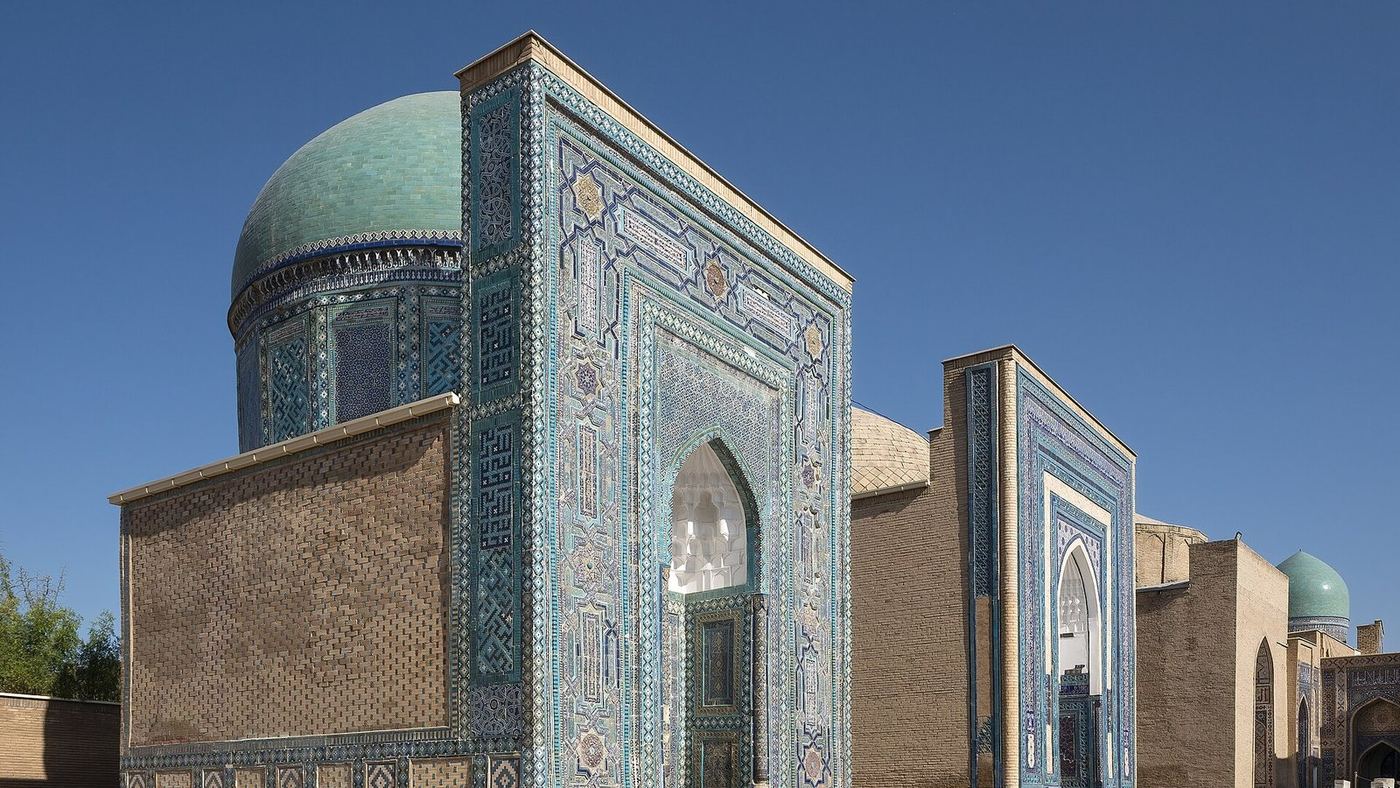
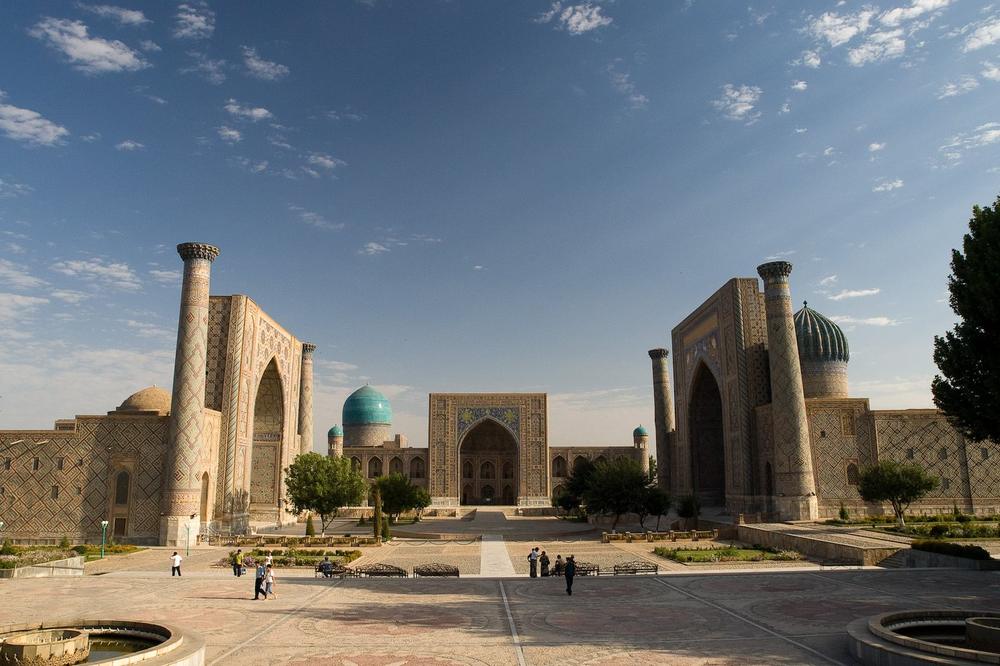
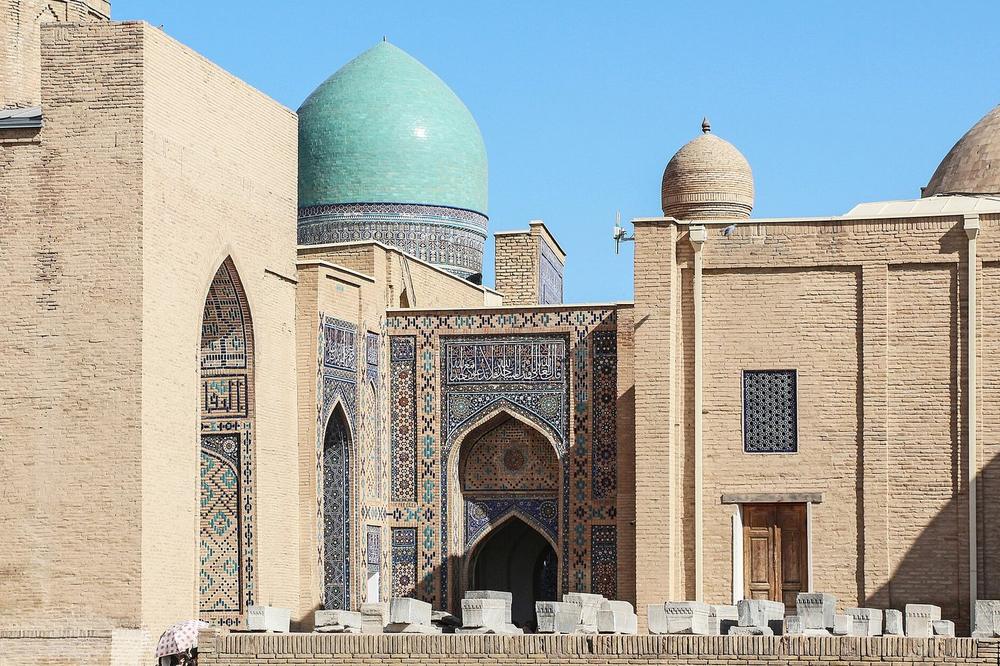
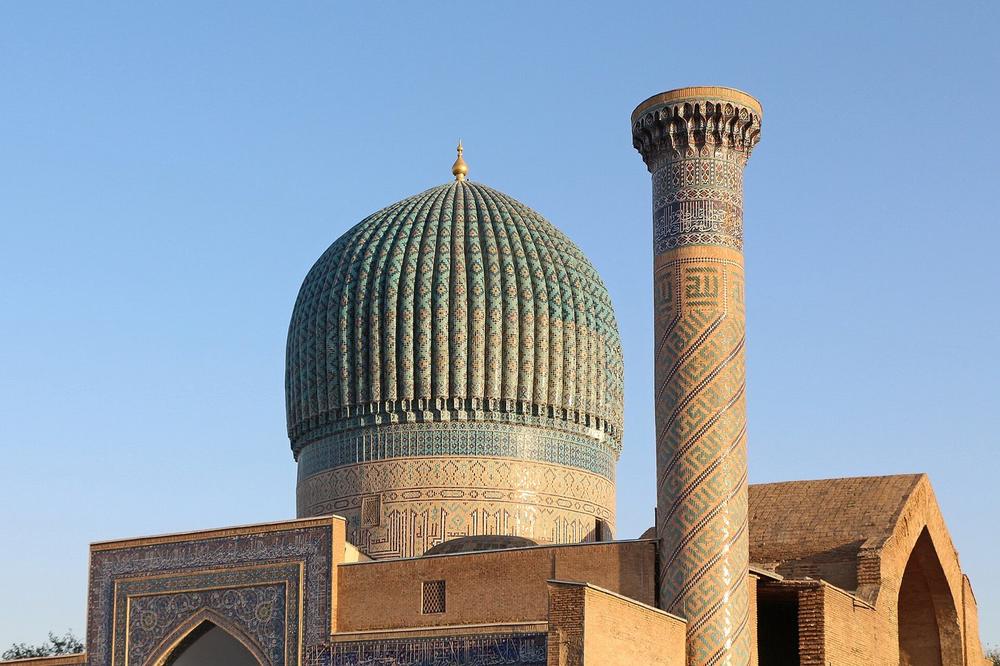
Samarkand was the seat of Timur and of the grandsons who ruled after him, and what they left is a small number of very large buildings. The Registan is three madrasas set at right angles around an open square, each one a portal the height of a church front with glazed tile carried across it. Shah-i-Zinda is the opposite proposition: a narrow stepped lane climbing a burial hill, tomb chambers shoulder to shoulder on both sides, and the tile close enough to read. Gur-e-Amir holds Timur himself under a ribbed dome. Bibi-Khanym stands half ruin and half reconstruction on the edge of the bazaar, and the hill of the pre-Mongol city sits north of all of it as ground rather than as architecture.
Here is the part a photograph will not tell you. These monuments are not joined by an old quarter. The city around them was replanned under Russian and then Soviet administration, so between one site and the next you cross boulevards, roundabouts and blocks of flats, and the walk that looks obvious on a map is often better done in a car. Only around Shah-i-Zinda and the bazaar does the older residential grain survive at street level. A traveller who has just come from Bukhara, where the old town is continuous and lived in, notices the difference within an hour and occasionally resents it.
The second thing to say plainly is how much of the surface is modern work. Tile falls off brick in a continental climate, and it has been replaced here for the best part of a century, first by Soviet conservation teams and again after independence. Some of the domes are re-clad. Some of the calligraphic bands are set anew. The proportions, the brickwork and the siting are the fifteenth century; a good deal of the colour is the twentieth and twenty-first. That is not a cheat and it is not a reason to stay away, but it is the difference between a monument and a ruin, and anyone who came for weathered stone should know which one this city offers.
What is unambiguously real is the scale. Nothing in the photographs prepares you for standing at the foot of a portal that runs three storeys before the arch even begins.
How many nights, and what breaks if you take fewer
Two nights, three if the trip can carry it. Two gives one full day and two usable ends of days, which is enough for the four principal sites without a march. Three gives the observatory hill, the paper mill on the river, the bazaar in the morning and, more importantly, a second attempt at whichever site the light was wrong for the first time.
What a day here actually contains
- Before eight. Shah-i-Zinda, at the gate, when the lane is empty and the sun is still low enough to reach into it. This is the single best hour the city has and it lasts about forty minutes.
- Mid-morning. Gur-e-Amir, which is interior work and does not care about the sun, then the bazaar beside Bibi-Khanym while the bread is still coming out.
- The middle of the day. Indoors, or in a courtyard with a tree in it. From June to September this is not a preference.
- Late afternoon into evening. The Registan, when the western portal takes the sun and the day groups have left for their hotels. The square is worth walking twice, once in daylight and once after the lights come up.
At a single night the day collapses into the middle of itself. You arrive on a train, you see the Registan at whatever hour you happen to be free, and you leave before the morning that would have made the trip. One night here is the commonest compromise in Uzbek itineraries and it is the one we push back on hardest, because the fix costs a hotel night rather than a flight.
The other reason for the third night is the road west. Bukhara is a morning away and Khiva is most of a day beyond it, so a schedule that leaves Samarkand at dawn to protect a Bukhara afternoon has quietly taken the good hours off this city. How the whole country divides up is set out on the Uzbekistan page, and the same sum for every country we sell is on how many days.
When to go
| Months | What it is like here | What it means for a day |
|---|---|---|
| April and May | Warm afternoons, cold mornings, the steppe still green | The strongest window of the year. Everything on the list above is comfortable and the courtyards are pleasant to sit in. |
| June | Heat arriving | Workable if the day is split. The middle four hours stop being useful before the month is out. |
| July and August | Around 40 degrees | Every one of these sites is unshaded brick and open tile. Out by eight, back in after five, and accept that the day has been cut in half. |
| September and October | The second window, and the one photographers ask for | Low sun on glazed surfaces, warm afternoons, cool nights. October is the month with the least to argue against it. |
| November to March | Cold, short daylight, occasional snow | Rates fall and the squares empty. Snow on a Timurid dome is one of the sights of Central Asia; the price is four or five usable hours a day. |
The seasonal problem in Samarkand is not rain, it is glare and shade. In the two good windows the tile reads as it was meant to, blue against a hard sky, and the portals throw enough shadow to stand in. In high summer the same surfaces are flat and white by ten in the morning. That is why the month matters more here than the itinerary does, and why we would rather move a trip than build a July one that pretends otherwise. The year across the region is on when to go.
Getting there and getting around
Almost everybody arrives on the Afrosiyob. Talgo-built, good for 250 km/h, and it puts about two and a half hours between the capital and this platform, which is why no sensible itinerary drives the leg. Seats go on sale exactly 60 days before departure, and on a strong month the best of them clear within hours, largely because tour operators take block allocations at once. For an April or an October trip, treat the 60-day mark as a fixed appointment rather than a suggestion.
Economy costs about 311,000 som at 2026 prices. Business is about 455,000 and the VIP saloon about 709,000. Converted into hard currency the first step is small and the extra seat width is not, which is why business is the default we book on a full train. If the seats have gone, the alternative is the road, and the road is not a disaster — it is simply most of a day where the train takes a morning, and it lands you here with the light already going.
Inside the city, use a car. The distances between the sites are short by the standards of an Asian city and long by the standards of a walk in forty degrees, the ground between them is main road rather than old town, and a driver waiting at each gate is what makes the early start and the late finish possible on the same day. Taxis are plentiful and cheap; on a guided itinerary the vehicle and the driver are already yours for the whole stay. Onward, Bukhara is a road morning to the west and there is no train worth the transfer time on that leg.
What it costs on the ground
Our country tiers put Uzbekistan in the cheapest of the four: roughly USD 190 to 300 a head for each day on the ground, at a party of four, land only, with hotel, the car and driver, the guiding and the entries inside that. Samarkand does not sit above the country average. Hotels here are plentiful at the middle grades and thin at the very top, which is unusual for a city this famous and works in a traveller's favour.
| What | Roughly, September 2026 | Note |
|---|---|---|
| Afrosiyob, economy | About 311,000 som | Tashkent to Samarkand, about 2 hours 30 minutes |
| Afrosiyob, business | About 455,000 som | Our default on a full train |
| Afrosiyob, VIP saloon | About 709,000 som | A wider seat rather than a different journey |
| Entry to the country | Nothing | 30 days visa-free, no form and no arrival card to pay for |
| A day on the ground, all in | USD 190 to 300 a head | Party of four, land only, at our standard of hotel and guiding |
You will notice there is no line for the Registan and none for Shah-i-Zinda. That is deliberate. Our September 2026 research pass could not obtain a published Uzbek tariff for either site, and what circulates instead is a spread of second-hand figures that do not agree with each other. This site does not print a number it cannot stand behind, and an entrance fee is exactly the sort of small number a reader checks. Ask, and we will pass on what was charged on the ground that month, labelled for what it is: a report and not a tariff. On our itineraries every entrance is inside the price either way. What a day costs elsewhere in Asia is on cost by country.
In pictures
When to skip it
- Your dates are in July or August and an early start is not going to happen. Around 40 degrees on open brick is not a question of stamina; it decides what you are willing to stand in front of and for how long.
- You want a city to wander in. This is a city to be driven between, with two stretches worth walking. Bukhara does the wandering and the Uzbekistan page explains how the two divide the country between them.
- Restoration bothers you on principle. A great deal of the colour here is modern work over old brick, and someone who wants patina rather than glaze will spend the visit conducting an argument with the buildings.
- Stairs and uneven ground are a problem. The lane at Shah-i-Zinda is a stepped climb, the observatory is cut into rock, and the old brick underfoot is worn round. Nothing here has been adapted and nothing is going to be.
- You are booking a peak-month departure inside eight weeks. The train window has closed, and what is left is a long road transfer and a first evening spent arriving rather than looking.
Journeys that come here
Uzbekistan in ten days gives this city three nights, takes the Afrosiyob out from Tashkent with the seats booked at the sixty-day mark, and then runs west to Bukhara and Khiva. It is the journey this page is written alongside and the reason the argument above is made in hours.
The Silk Road in sixteen days reaches Samarkand from the other direction and then climbs east into Kyrgyzstan, which is the summer traveller's answer: those mountains are open in the months when these courtyards are not. For how the four Uzbek cities divide a fortnight between them, and where the nights should come from, read the country page next.
Give us the month, then the wish list
The season and the sixty-day train window decide more about a Samarkand stay than any preference does. Send the dates and the first thing we will tell you is which trains and which months are still open.
Questions travellers ask most
Is two nights enough, or do we really need three?
Two nights covers the four principal monuments without hurrying: one full day, plus the evening you arrive and the morning you leave. If the itinerary is tight and Bukhara and Khiva are both in it, two is a defensible choice and we will build it.
Three buys two things. The first is the Ulugh Beg observatory, the paper workshop and the bazaar, none of which fit into a day that already has the Registan and Shah-i-Zinda in it. The second is a second chance at the light, which matters here more than at any other site in the country because glazed tile is either reading well or it is not.
What happens if the Afrosiyob is sold out?
You go by road. It is not dangerous and it is not uncomfortable, but it turns a two-and-a-half-hour morning into most of a day, and it usually costs you the first evening on the square, which is one of the two hours worth being here for.
The way to avoid the question is to fix your dates early. Sales open exactly 60 days out and the Tashkent departures can clear within hours because tour operators take their allocations as soon as sales open. Turning up at the station on the morning buys nothing.
Why are there no entrance prices on this page?
Because we could not verify them. In September 2026 no official Uzbek price sheet for the Registan or for Shah-i-Zinda could be obtained, and the figures floating around on blogs and forums contradict one another. Printing one of them would be guessing in public.
It makes no difference to what you pay us, because entries are inside the price of every itinerary we build. If you want the current figure before you fly, ask, and we will report what was charged on the ground that month with that caveat attached.
Can Samarkand be done as a day trip from Tashkent?
Mechanically, yes. The train is fast enough that people do it, and if you have one spare day in the capital it beats spending it in the capital.
It is still the wrong shape. A day trip puts you here between about eleven and four, which is the window when the sun is flattest, the coach parties are thickest and Shah-i-Zinda is at its worst. The two hours that make this city are first thing and last thing, and both of them are on the wrong side of a return train. If the schedule genuinely allows only a day, we would rather rearrange the nights than sell you the version that arrives at lunchtime.
Read next
Tell us about the journey you have in mind
Dates, party size and the places you care about are enough to start. You get a draft route and an indicative price, not a brochure.