Four walled cities, one land border, and a lake above the passes
The oasis half and the mountain half of the same road, taken in the order the caravans took them. Ten nights in Uzbekistan for the brick and tile, five in Kyrgyzstan for the grass, the horses and the altitude.
At a glance
- Duration
- 16 days, 15 nights
- Party
- Private, 2 to 8
- Starts
- Tashkent
- Ends
- Bishkek
- Countries
- Uzbekistan 10 nights, Kyrgyzstan 5
- From
- USD 4,600
Most Silk Road itineraries stop where Uzbekistan stops, which makes them city journeys about architecture. The road itself did not stop there. It went on east through the Fergana valley, over the ranges and into the pasture country that fed and remounted every caravan that crossed them, and that half is grass, horses and altitude rather than tile.
Sixteen days buys both halves and the join between them. The join is the point: you leave Uzbekistan on foot at a land crossing in the Fergana valley and pick up a Kyrgyz car and a Kyrgyz guide on the other side, which is roughly how the transition has always worked and is a great deal more interesting than a flight through a hub.
If mountains are not the reason you are going, the ten-day Uzbekistan journey covers the four cities and runs west to the Khiva end rather than looping back. This one is for people who want the road to keep going after the last madrasa.
Day by day
The season is set by a pass, and nobody publishes the date it opens. The high roads of the Tien Shan and the corridor reached from Osh are usually travelled at the height of summer, and comfortable high-altitude travel runs from roughly mid-June to September. Those are working ranges rather than a schedule: there is no roads authority anywhere in the region publishing an opening day, and a late snow year moves everything. We will not quote you a date for the Song Kul road, and anybody who does is guessing. What we do instead is hold an alternative route in the Kyrgyz half of every June and September departure.
The Afrosiyob sells out at sixty days. Booking for Uzbekistan’s high-speed service opens 60 days before departure and seats can be gone within hours, partly because operators take block allocations the moment it lifts. On this route the train carries the leg that puts you back in Tashkent in time for the border day, so the consequence of missing it is not merely a long drive — the Kyrgyz half moves with it. Reach us before the window opens and none of this is your problem.
Neither country needs a visa, and both watch a border you will not go near. US, UK, Australian and most EU passports enter Uzbekistan visa-free for 30 days and Kyrgyzstan visa-free for 30 days. There is nothing to apply for and nothing to buy. Both countries sit at Level 1 on the US advisory scale, the lowest band there is; the Kyrgyz entry, updated on 10 February 2026, adds a caution within 30 km of the Tajikistan border, where there is a history of clashes. Nothing on this itinerary approaches that strip, and we will not add a Pamir extension that does.
Arrive Tashkent
Flights from Europe land at an hour that suits nobody, so the room is held from the night before wherever the hotel will do it and the first day is shapeless on purpose. Sleep, then a walk when you are ready.
Tashkent is the least Silk Road thing in Uzbekistan and it is a useful introduction anyway. Broad avenues, plane trees, fountains and a Soviet ministry every few hundred metres: this is the administrative capital of Central Asia as the twentieth century built it, and the three cities that follow will make more sense for having seen what replaced them.
Tashkent, and the oldest book in it
Khast Imam in the morning for the Uthman Quran, a manuscript on deerskin that is among the oldest surviving copies anywhere. Its history is as interesting as the object: taken to St Petersburg after the Russian conquest, returned by the Bolsheviks as a political gesture, and now kept behind glass in a room that asks for silence and mostly gets it.
Afterwards the Museum of Applied Arts, which is housed in a Russian diplomat’s mansion and is the best place in the country to look at suzani embroidery and ikat closely before you start seeing them for sale in every bazaar. Lunch at the osh markazi, where plov is cooked in cauldrons the size of a bath and sold by the kilo until it runs out, usually by two.
West to Khiva
A morning flight the length of the country to Urgench, then about forty minutes by road across irrigated cotton to Khiva. You are now in Khorezm, which was a separate country for most of its history and still feels like one: the accent changes, the bread changes shape, and the desert starts at the edge of the fields.
The Ichan Kala is the walled inner city and your hotel is inside it, which is the whole trick. Day visitors come by coach from Urgench and leave in the late afternoon, and the streets between the walls are then almost entirely yours until the following morning.
Khiva, which is a museum and knows it
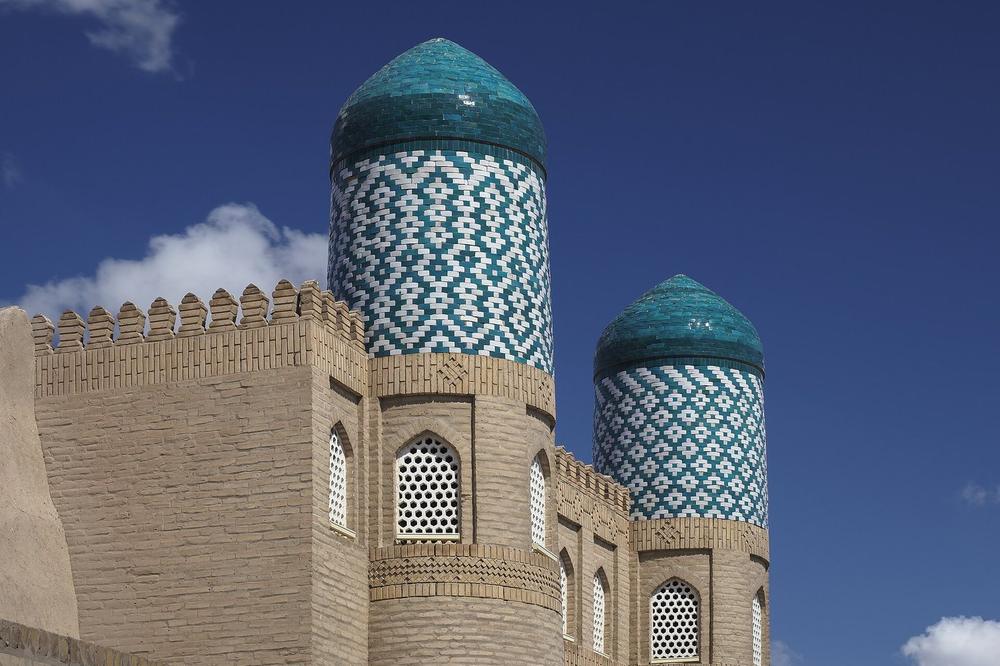
The morning is the Kunya Ark, the khans’ fortress, with its throne courtyard and the summer mosque tiled floor to ceiling in blue and white, and the Tash Hauli palace next door, where the harem courtyard carries the best tilework in the city and a set of carved wooden columns on stone bases shaped like camel feet.
The uncomfortable part of the history is worth having straight. Khiva ran one of the largest slave markets in Asia, supplied by Turkmen raiders working the Persian and Russian frontiers, and it was the last of the three khanates to fall to Russia. A good guide will tell you this without being asked and without dressing it up.
The afternoon is loose: the wall walk, the Pahlavan Mahmud mausoleum, where a wrestler-poet became the town’s patron saint and got the finest tiled chamber in Khorezm for it, or the silk carpet workshop where the dyes still come from madder, indigo and pomegranate rind.
Across the Kyzylkum to Bukhara
The desert day. The road runs southeast across the Kyzylkum with the Amu Darya somewhere off to the right, and for several hours there is sand, saxaul scrub, and the occasional shepherd who is a very long way from anything. Lunch is at the roadside place that exists rather than the one you would choose, and the tea is the good part.
That emptiness is the honest reason the desert cities were worth what they were worth. Bukhara appears at the end of it as a low brown town with domes in it, and the first thing you do is sit down by the Lyab-i-Hauz pool under the mulberries and stop moving.
Bukhara on foot, which is the only way it works
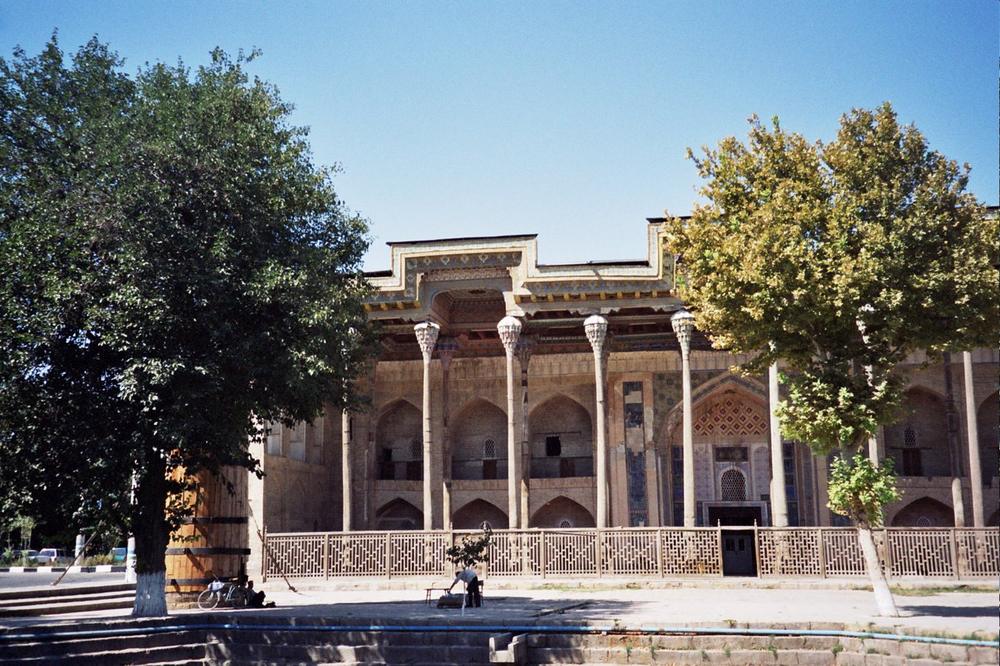
Bukhara was a university town before Europe had universities, and the reason to spend a whole day walking it is that the monuments are not laid out for visitors — they are the ordinary furniture of a lived-in old town. Start at the Bolo Hauz mosque, whose painted wooden columns are doubled by the pool in front of them, then up to the Ark, the walled citadel from which the emirs governed until the last of them was removed in 1920.
Under the Ark is the pit where two British officers, Stoddart and Conolly, were held before their execution in 1842 — the Great Game at its least glamorous, and a story your guide will tell better standing there than any book tells it. Afterwards the Kalyan ensemble, the covered trading domes, which still trade, and Chor Minor, a gatehouse with four unequal towers hidden in a residential lane where nobody finds it by accident.
Late afternoon at Char Bakr, the necropolis on the edge of town, which is empty, unrestored and the quietest thing in Bukhara.
Bukhara to Samarkand
East by road through the Zarafshan valley, which is green in a way nothing since Tashkent has been: cotton, orchards, canals and villages selling melons off the tailgate. It is a morning rather than a day, and it ends at the city the whole route has been building towards.
The first afternoon is Gur-e-Amir, where Timur lies under a slab of dark jade with his teacher, his sons and two grandsons around him. It is a small building compared with what comes tomorrow, and it is the one that makes the best sense of the man: he built an empire from Delhi to Ankara and chose to be buried at his teacher’s feet.
Samarkand, and how much of it is a reconstruction
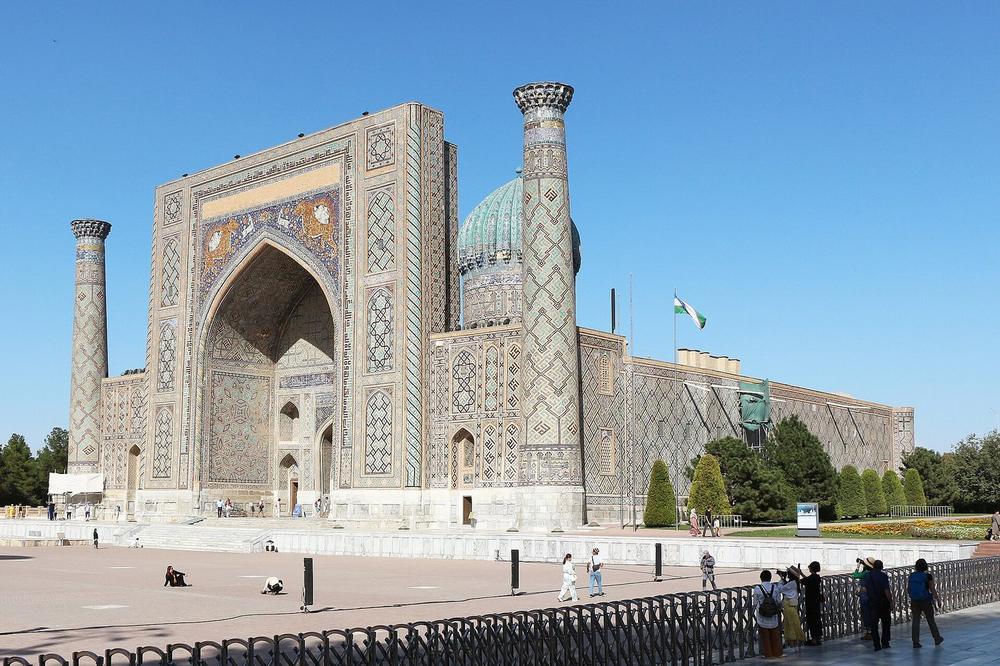
The Registan first thing, because the tile takes low sun and because the square empties for an hour after the first coaches leave and before the next arrive. Three madrasas on three sides, built across two and a half centuries, facing inwards onto what was the civic centre of an empire and later a grain market.
Then the thing most pages avoid saying: a great deal of what you are photographing is twentieth-century work. Soviet restorers rebuilt collapsed domes, re-cut tile and straightened a leaning minaret with cables, and the programme continues today. This does not make Samarkand less worth crossing the world for. It does mean the honest question at each building is which centuries you are looking at, and a good guide answers it rather than skating over it.
Bibi Khanym after lunch — built too big and too fast, falling down within the builder’s lifetime, and still enormous — then the Siyob bazaar behind it for bread stamped with a wooden seal, and dried apricots that taste nothing like the ones sold at home.
Shah-i-Zinda at opening, and an astronomer prince
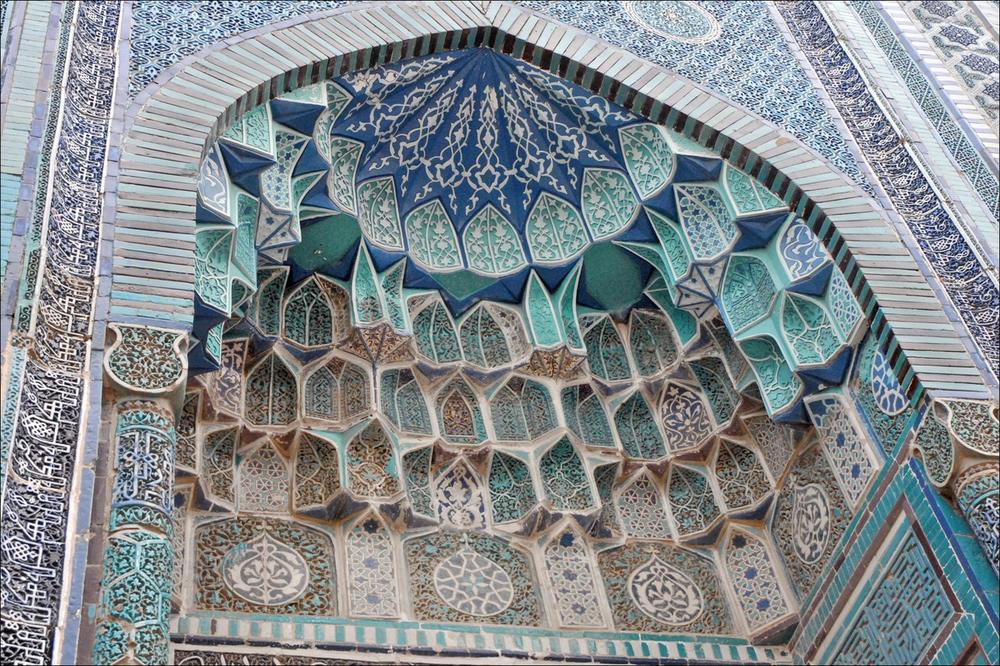
Be at the Shah-i-Zinda gate when it opens or do not go at all. The site is a stepped lane with tomb chambers on both sides, faced in tile by three centuries of different workshops, and it is narrow enough that forty visitors turn it into a corridor. Arrive first and it is a street of blue with nobody standing in it — the best twenty minutes in the country.
The rest of the morning is the Ulugh Beg observatory, where what survives is the buried arc of an enormous sextant cut into bedrock. Timur’s grandson sat here and worked out the length of a year to a figure modern astronomers would quarrel with only at the margins, and produced a star catalogue that held its authority for two centuries. A faction that preferred a less inquisitive ruler had him killed for it.
The afternoon is free and the suggestion is the other Samarkand: the Russian colonial grid west of the old city, laid out after 1868, with its boulevard, its plane trees and its cafes. Two cities, one grid drawn across the other, and almost nobody walks the newer one.
The Afrosiyob back to Tashkent
A late-morning departure, roughly two and a half hours on a Talgo set that touches 250 km/h and covers ground the car needs most of a day for. Three classes are sold: at 2026 prices the economy seat is in the region of 311,000 som, business about 455,000 and the VIP saloon around 709,000. Business is what we book without asking, because these trains leave full and the extra room is the whole difference on a morning like this.
The afternoon in Tashkent is deliberately unambitious, because tomorrow is long. Ride four or five metro stations, which are vaulted, chandeliered and built deep because they were designed to double as shelters, and where photography was forbidden for most of their working life. Then Chorsu bazaar under its blue dome at the end of the day, when the traders are cutting prices rather than starting them.
Over the Kamchik pass and out of Uzbekistan
The long day, and the one people remember. There is exactly one road from Tashkent into the Fergana valley and it climbs over the Kamchik pass through a gap in the mountains, with tunnels, switchbacks and lorries. On the far side the valley opens out into the most densely farmed and most densely populated country in Central Asia.
We break at Margilan, where silk has been woven since the road ran through it and where the workshop still boils cocoons, reels the thread by hand and ties the warp for ikat before dyeing it — which is why the pattern on atlas cloth has that blurred edge. If the day is running well, the blue-glaze pottery kilns at Rishton are the second stop; if it is not, we skip them and say so at the time.
The crossing itself is at Dostyk, near Andijan. You walk it: out of the Uzbek hall with your own luggage, across a strip of no-man’s-land, into the Kyrgyz hall, where a different guide and a different car are waiting. Neither passport needs a visa, so the whole thing is stamps and queueing rather than paperwork. Osh is under an hour beyond it.
Osh, the oldest city in the country
Sulaiman-Too rises straight out of the middle of Osh, a limestone ridge with petroglyphs on it, caves used as shrines and a small mosque that Babur built on the summit before he left to found the Mughal empire. Pilgrims still climb it, mostly women, mostly for reasons that have nothing to do with the archaeology, and the stair is steep and unshaded.
The Jayma bazaar runs a long way along the river and is the reason to be here: knives from Tuluk, felt, horse tack, kalpak hats, whole sheep, and the sound of a market that has been trading on this spot since long before anyone thought to date it.
One thing to know rather than to worry about: Osh is a majority-Uzbek city in Kyrgyzstan and it saw serious inter-ethnic violence in 2010. What a visitor meets today is an ordinary, busy provincial city, and Kyrgyzstan as a whole sits at Level 1 on the US advisory scale. We would rather you heard that from us than found it in a search after you had booked.
North to the Kochkor valley
A morning flight over the ranges to Bishkek — the road version is two days and a pass, and the flight is the sensible use of a day — then east along the Chuy valley and up into Kochkor, a small town at the head of the road that leads to the pastures.
Kochkor is where the felt comes from. The women’s cooperatives here make shyrdak, the cut-and-inlaid felt carpet that is the actual furniture of a yurt, and you can watch a piece being made rather than just bought: wool washed, rolled, boiled, dyed, cut in mirrored halves and stitched together so that neither half is background. It takes two women a long time, and they will tell you exactly how long.
Over the pass to Song Kul
Up onto the high pasture, and this is the day the route exists for. The track climbs in tight switchbacks onto a plateau where there are no fences, no poles and no buildings except felt ones, and then the lake appears: a sheet of water in a bowl of grass, with herds and horses on every side of it and nothing on the shore.
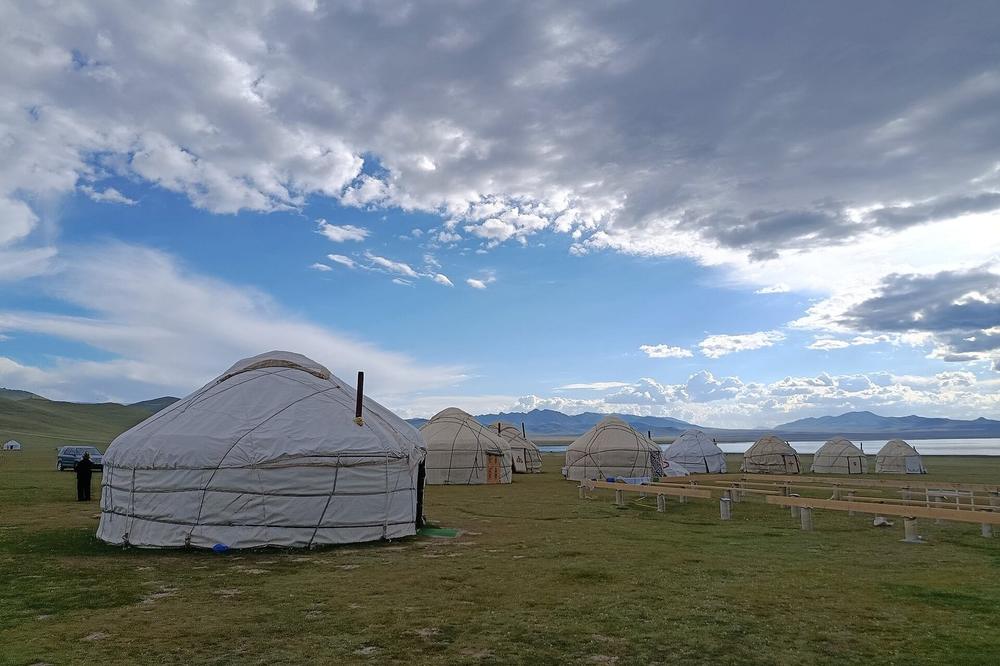
The camp is yurts. That means a felt tent with a stove, a shyrdak floor, a shared washblock or a pit latrine depending on the camp, no mains electricity beyond a solar lamp and no telephone signal at all. It is cold after dark even in August, and it is one of the great nights in Asia. Ride if you ride; walk the shoreline if you do not; help bring the herd in at dusk if the family will let you, which they usually will.
What we will not do is promise you this in early June or late September. The road over the pass is seasonal, no authority publishes an opening date, and if the snow says no we run the Kyrgyz half at lower altitude instead and tell you before you leave home.
Down to the Chuy valley and Bishkek
Off the plateau in the morning and back down the switchbacks, which look entirely different in daylight going the other way, then west along the valley towards the capital.
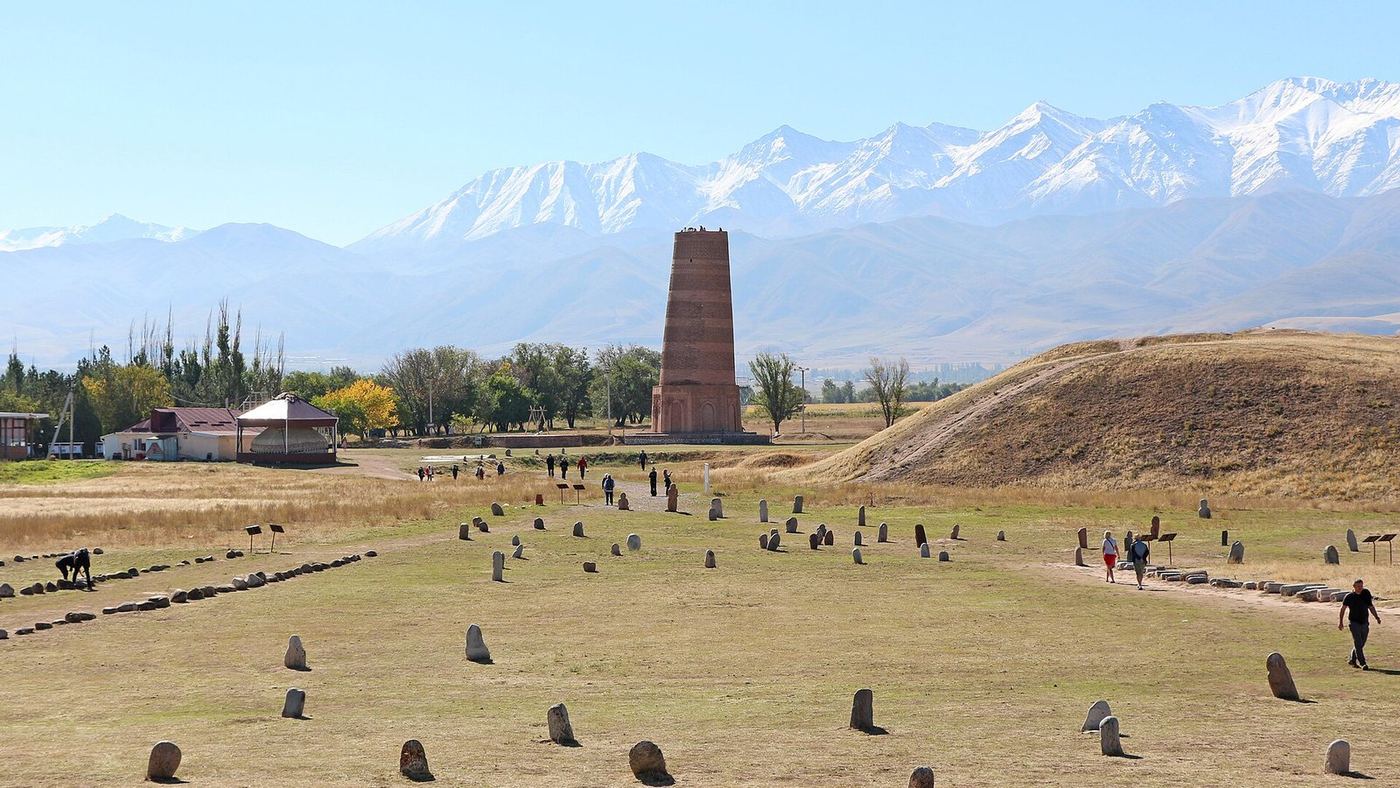
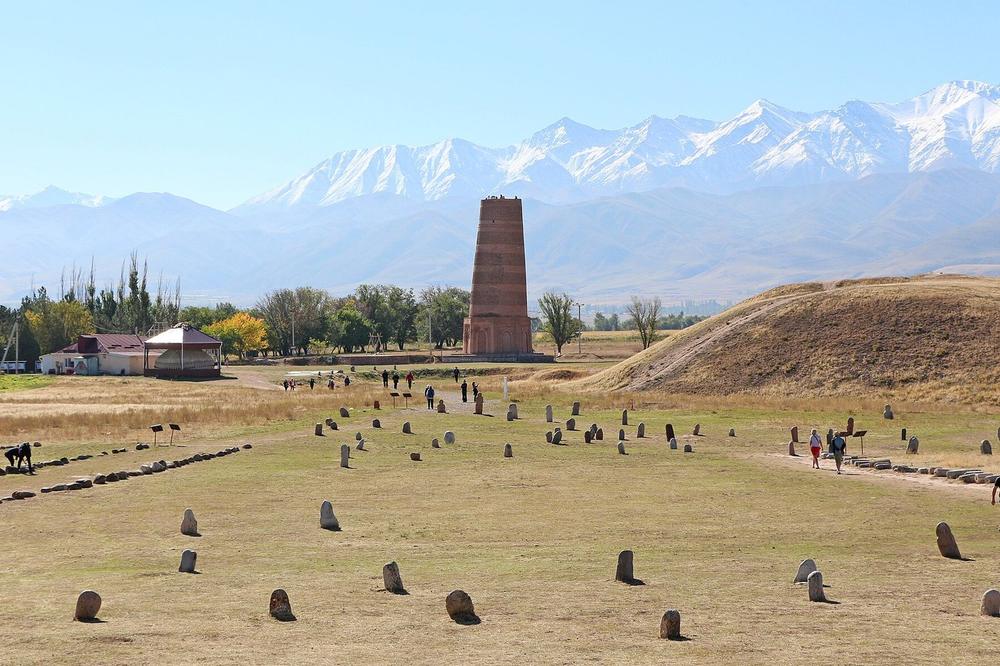
The stop is Burana, where a stub of a Karakhanid minaret stands alone in a field with the mountains behind it and the town it belonged to has vanished completely into the grass. Around it somebody has gathered a collection of balbals, the carved stone grave-markers of the Turkic nomads, which stand in rows looking mildly surprised. You can climb the minaret by a dark internal stair if you are neither tall nor claustrophobic.
Bishkek in the late afternoon: a planned Soviet grid with irrigation channels running down both sides of every street and the Tien Shan filling the end of each one. An hour at the Osh bazaar and dinner is the right shape for a last evening.
Depart Bishkek
Manas airport is about forty minutes out of the city and most long-haul connections leave at an hour nobody would choose, which is worth knowing before you book the flight home. If yours goes late, you keep a room for the day rather than a seat in a lobby.
What it costs
| Party size | Comfortable | Considered |
|---|---|---|
| 2 travellers | USD 6,250 | USD 8,500 |
| 3 – 4 | USD 5,200 | USD 7,050 |
| 5 – 8 | USD 4,600 | USD 6,250 |
Where the lowest number comes from: Uzbekistan and Kyrgyzstan both sit in tier D on our country table, USD 190 to 300 per person per day for land arrangements, and USD 4,600 over sixteen days works out at about USD 288 a day. That is near the top of the band rather than the middle, which needs explaining, given that few countries we sell cost less per day than Uzbekistan taken on its own.
Three things push it up. Two national guides and two vehicles rather than one of each, because a Kyrgyz guide cannot work in Uzbekistan and neither car crosses the border. Two internal flights, Tashkent to Urgench and Osh to Bishkek, which buy back three days of driving. And the mountain leg, where a high-clearance vehicle, a driver who waits at the lake and a yurt camp that holds two or three parties at a time cost several times what a night in Bukhara costs.
Party size still moves the number more than anything else. Two people carry a whole car, a whole guide and the same border assistance between them; five split the identical bill, which is why the two-traveller column stands 36 per cent above the five-to-eight one and the hotel grade changes the total far less than you would expect.
Comfortable means a merchant house turned hotel behind the walls at Khiva and another in the Bukhara lanes — in both towns these are simply the best rooms going, whatever you are willing to spend — a dependable four-star in Tashkent and Samarkand, and a family guesthouse at Kochkor. Considered moves you into the international brands where the two large cities have them and into the biggest rooms where they do not. At Song Kul it buys precisely nothing: every grade sleeps in felt, and no more expensive yurt exists for us to sell you.
You will notice no admission prices anywhere on this page for the Samarkand or Bukhara monuments. That is not an oversight. No Uzbek government price sheet could be obtained when this page was written, the figures repeated on travel blogs disagree with one another, and a fee we cannot stand behind is a fee we do not publish. All of them are inside your quote at cost regardless. For what a day on the ground buys across Asia before margin, see the prices page.
What is and is not included
What the price includes
- Fifteen nights as listed, each property named in your quote before you pay anything — including which yurt camp
- A national guide in Uzbekistan and a second in Kyrgyzstan, each with you for their own country
- A private car and driver on both sides of the border, and a high-clearance vehicle for the Song Kul road
- Afrosiyob seats on the Samarkand to Tashkent leg, booked at the 60-day mark
- Both internal flights: Tashkent to Urgench, and Osh to Bishkek
- The land crossing at Dostyk with assistance on both sides and a handover in the arrivals hall
- Admission to everything named in the itinerary, at cost, plus the Margilan silk workshop and the Kochkor felt cooperative
- Meals as listed, all three meals at Song Kul, and drinking water in the vehicle
What it does not include
- International flights into Tashkent and out of Bishkek
- Visas, which US, UK, Australian and most EU passports do not need for 30 days in either country
- Travel insurance, which we require and do not sell — and which must carry an altitude ceiling above the Song Kul camp
- Horse hire at Song Kul, which is arranged with the family on the day
- Meals not listed above, and all drinks
- Tips, which are customary in both countries and never built into our prices
The journey in pictures
Who this journey is wrong for
- Anyone whose dates fall outside roughly mid-June to September. The Kyrgyz half is the second half, the road to Song Kul is seasonal, and no authority publishes an opening date for it. In May, or in October, this becomes a different journey at lower altitude and we would rather sell you the ten-day Uzbekistan route than a mountain trip with no mountains in it.
- Travellers who need a bathroom of their own every night. Song Kul is a felt tent with a stove, a shared washblock or a pit latrine, no mains power and no telephone signal, and it is cold after dark in August. There is no upgrade available and buying a more expensive grade does not produce one.
- Anyone who cannot walk a land border carrying their own bag. The Dostyk crossing is done on foot, in a queue, with your luggage, and the halls have no trolleys and no lift. It is straightforward and it is not accessible.
- People who book inside sixty days for a peak departure. Afrosiyob seats go on sale 60 days out and can be gone in hours; on this route that train is what puts you in Tashkent the night before the border day, so losing it moves more than one leg.
- Anyone hoping to add Tajikistan and the Pamir Highway. It is the natural-looking extension on a map and it is not one here: the US advisory flags a 30 km strip along the Kyrgyz–Tajik border where there is a history of clashes, and the Pamir corridor needs its own two weeks rather than three spare days at the end of this one.
How this compares
| Journey | Days | Countries | From |
|---|---|---|---|
| Silk Road | 16 | Uzbekistan, Kyrgyzstan | USD 4,600 |
| Uzbekistan | 10 | Uzbekistan | USD 2,700 |
| Georgia and Armenia | 11 | Georgia, Armenia | USD 3,100 |
| Grand Indochina | 22 | Vietnam, Laos, Cambodia | USD 6,900 |
The six days that separate this from the ten-day Uzbekistan journey do not buy more Uzbekistan. They buy a second country with a different economy, a different language family and a different way of housing you, and they buy the road between the two rather than a flight over it. Anybody who wants a fifth and sixth Uzbek city instead — Shakhrisabz, Nukus and the Savitsky collection — should ask for that version and we will build it, but it is a quieter trip and it should be sold as one.
The country itself, its cities and the choice between its two narrow seasons are covered on the Uzbekistan page and month by month under when to go. Why one particular city earns a third night is set out on the Samarkand page. Where both countries currently stand on the advisories, and what that does and does not stop us selling, is on safety and advisories.
Tell us your month first
Send the month before anything else, because on this route the month decides whether the second half is possible at all. Give us that and the number of travellers and you will have a draft itinerary inside two working days.
Questions travellers ask most
When can this journey actually run, and why will you not give us dates?
The mountain half depends on a seasonal road. High routes in the Tien Shan and the corridor reached from Osh are usually travelled at the height of summer, and comfortable high-altitude travel runs from roughly mid-June to September. That is the whole of what anybody can honestly say.
There is no roads authority in the region publishing an opening and closing date, and a heavy winter or a late thaw moves the whole window. September is the month that suits both halves best: the passes are usually still open and the Uzbek cities have come off their summer heat. July and August are the safest bet for the mountains and the hardest work in the desert cities, which are unshaded brick and tile from ten in the morning.
How does the border crossing work, and do we need visas?
You do not need a visa for either country. US, UK, Australian and most EU passports get 30 days visa-free in Uzbekistan and 30 days visa-free in Kyrgyzstan. Nothing to file, nothing to pay, and no registration form that any website is entitled to charge you for.
The crossing at Dostyk, near Andijan, is done on foot. Your Uzbek guide and driver take you to the gate, you clear the Uzbek hall with your own luggage, walk the strip between the two posts and clear the Kyrgyz hall, where the Kyrgyz guide and car are waiting on the other side of the barrier. It usually takes under an hour and occasionally takes rather longer, which is why the day has nothing scheduled after it beyond the drive into Osh.
What is a night at Song Kul really like, and is the altitude a problem?
A felt yurt with a wood stove, layered quilts on a shyrdak floor, a shared washblock or a pit latrine, solar lamps and no telephone signal. Dinner is with the family who own the herd. It gets cold enough after dark in August that the stove is lit, and the camp holds two or three parties rather than twenty.
On altitude: the lake sits high on an open plateau and you reach it from a night spent considerably lower, so a headache and a broken night’s sleep are common and anything worse is not. Anybody with a heart or lung condition should speak to their doctor before booking, and everybody should read the altitude ceiling written into their travel policy, because standard cover often stops below the height of this camp.
Why does this route double back to Tashkent instead of flying straight on?
Because the Fergana valley is the road east, and there is only one of it. The single land route from Tashkent into the valley climbs the Kamchik pass, and the crossing into Kyrgyzstan is at the far end of it near Andijan. Going back through the capital is not a detour; it is the way the geography works, and it buys you Margilan and the pass on the way.
The alternative is a flight from Tashkent to Osh or Bishkek, which we will book if you prefer it and which costs you the most interesting day on the itinerary. The ten-day Uzbekistan journey runs the other way for exactly this reason: with no onward border to reach, it finishes in the west and flies out of Urgench rather than returning.
Read next
Tell us about the journey you have in mind
Dates, party size and the places you care about are enough to start. You get a draft route and an indicative price, not a brochure.