Three islands, sixteen nights, and a timed slot on Padar
Java for the monuments and the caldera, Flores for the water and the lizards, Bali for the week that puts you back together. One country, three islands that share little beyond a flag, and two internal flights planned around ash rather than around price.
At a glance
- Duration
- 17 days, 16 nights
- Party
- Private, 2 to 8
- Starts
- Yogyakarta
- Ends
- Bali
- Islands
- Java 5 nights, Flores 4, Bali 7
- From
- USD 5,400
Indonesia is not a country you cross. It is a line of islands about as long as the distance from Ireland to Kazakhstan, and any honest seventeen-day route picks three of them and leaves the rest alone. This one takes Java for what was built, Flores for what swims and walks, and Bali for the part where you stop moving.
The shape is deliberate. Java first, because monuments before nine in the morning are a different experience from monuments at noon and the body will still be on European or American time for the first two days. Flores in the middle, because the Komodo boat days are the part that cannot be rescheduled from the far end of the trip. Bali last, because seven nights of Bali after nine nights of moving is a holiday, and seven nights of Bali first is an anticlimax.
Sixteen nights across five beds. That is unusually settled for a voyage of this length — the twenty-two-day Grand Indochina uses nine — and it is possible only because Komodo is worked from a single town and Bali is worked from two valleys rather than four coasts.
Day by day
Padar is now a timed booking, not a ticket. Komodo National Park caps the South Padar visitor area at 1,000 people a day, split across three entry sessions — 05:00 to 08:00, 08:00 to 11:00 and 15:00 to 18:00 — allocated through the park’s SiORA system. The scheme was trialled from October 2025 and has been enforced since April 2026. A slot is held against a named calendar date. That single sentence is why this journey gives Labuan Bajo four nights instead of two: a party that turns up with three days of sea weather and one session booked has nowhere to move it to.
The park charges are per person, per date, and they are itemised. Foreign entry to Komodo National Park is IDR 700,000 for a set calendar date, plus a harbour fee of IDR 25,000, plus IDR 25,000 a day if you dive, plus a ranger fee of roughly IDR 120,000 to 150,000 for the group. All of it is in your quote at the rate we pay, and all of it is dated to September 2026.
Volcanic disruption is an aviation problem, not a sightseeing one. More than seventy volcanoes in this country are officially active. Anak Krakatau, out in the Sunda Strait, shut both of Jakarta’s airports on 6 and 7 September 2026 — they reopened at 08:59 on the second day — and put 108 flights to and from Bali into cancellation or rescheduling. Mount Lewotobi Laki-Laki, at the eastern end of Flores, has been at elevated alert since its major 2025 eruption, with the British advice against all travel within 7 km of the crater and near-daily minor ash through 2026; Bali’s airport stayed open throughout September 2026 with no closure attributed to it. Nothing on this route goes near Lewotobi, which sits several hundred kilometres east of Labuan Bajo. What we do instead is carry a flex day and refuse same-day onward connections.
Arrive Yogyakarta
You land into the flat green middle of Java, and the airport is a long way out of the city it serves. Nothing is scheduled beyond the transfer and a briefing over tea about what the next two weeks actually contain, which is the conversation most operators have by email and we prefer to have in a chair.
Yogyakarta is a sultanate. Not a former one — the reigning sultan is also the governor of the province, which holds a constitutional status no other part of the republic has. That fact explains most of what you will see in the next three days, from the orientation of the palace to the reason the city has resisted becoming Surabaya.
Borobudur, and the two temples nobody stops at
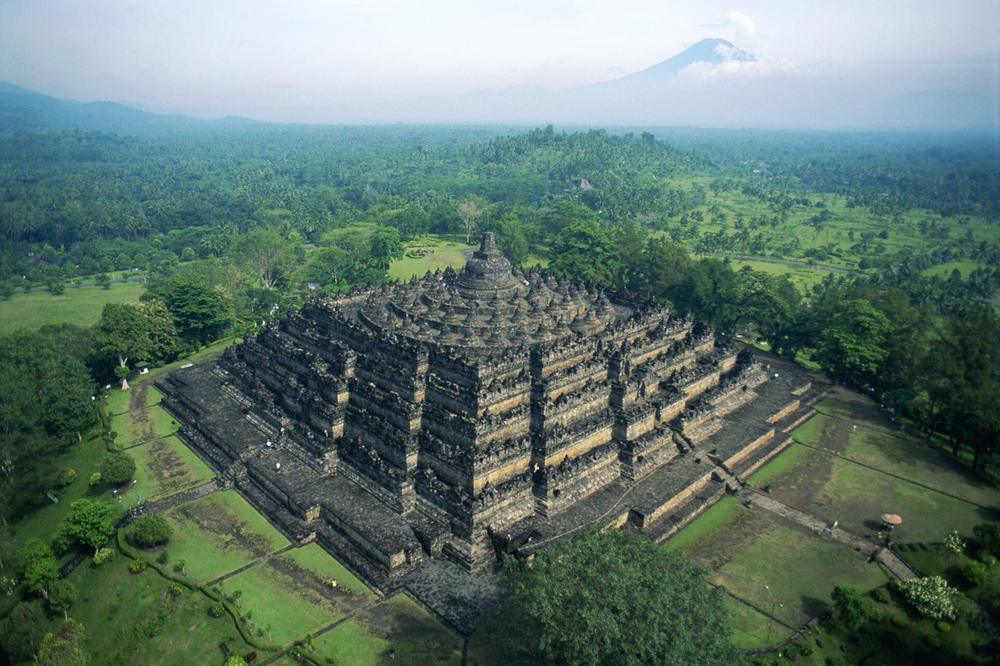
Out before the light for Borobudur. What you are climbing is not a building with rooms in it but a solid stone hill dressed as a diagram: gallery after gallery of carved narrative at the bottom, perforated bell-shaped stupas above, and an empty one at the summit. Centuries of volcanic ash and jungle buried it, which is the only reason so much of the carving survived.
The part most itineraries skip is the line. Borobudur, Pawon and Mendut sit on a single straight axis running east, and pilgrims arrived along it rather than at the car park. Mendut holds a seated Buddha cut from a single block, taller than the people who come to sit in front of it and still receiving offerings, and almost nobody goes.
On the price of climbing to the upper terraces: access to the top is controlled separately from entry to the grounds and the rule has been rewritten more than once. We confirm the position with the park in the week before you travel and put the figure on your invoice rather than on this page, because the numbers circulating online disagree with each other.
Prambanan, and the city itself
Prambanan went up within decades of Borobudur, a few kilometres the other side of the city, and it argues the opposite case: Hindu instead of Buddhist, vertical instead of terraced, three tall towers for Shiva, Vishnu and Brahma rather than one hill. Half of what stands has been re-erected from collapsed stone, and the 2006 earthquake put some of it back on the ground.
The afternoon belongs to the living city. Kraton Yogyakarta is still occupied and still staffed by retainers in court dress, which makes it a working household rather than a museum. Behind it, the Taman Sari water castle is a ruined bathing complex of tunnels and sunken pools that the neighbourhood has simply built into, so you come out of a Sultanate corridor into somebody’s washing line.
East across Java to the Tengger caldera
A full day of travel and the only way to make it pleasant is to put the long flat part on rails. Train east across Java, then a car for the climb, which is the section worth having a driver on: the road rises out of the plain through terraced onion fields and does not stop rising until the tarmac ends at the rim.
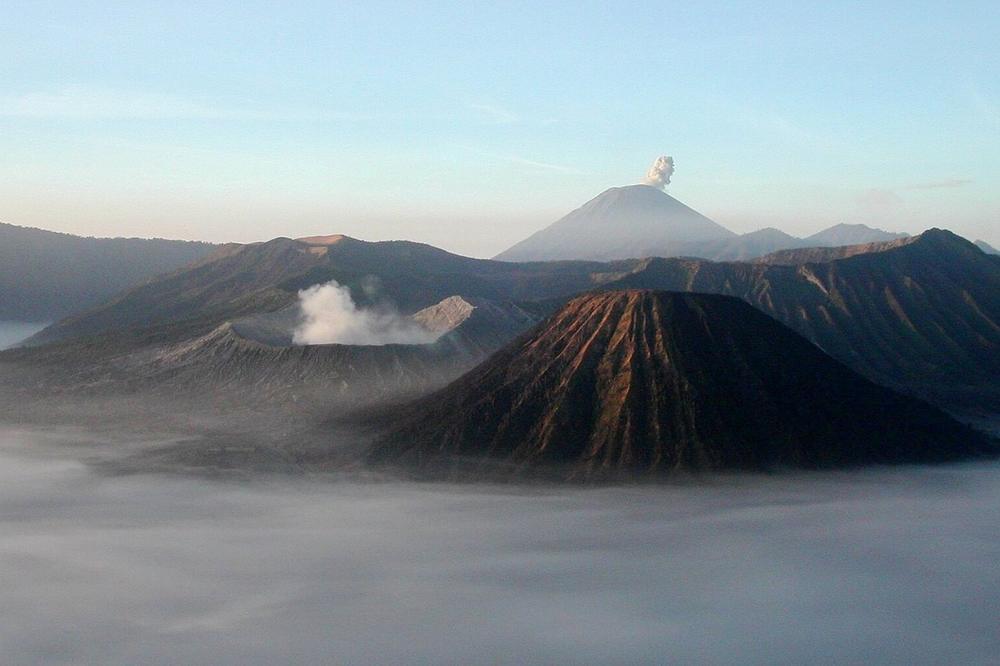
Cemoro Lawang is a short string of houses standing on the lip of the Tengger caldera, and it is cold after dark in a way nothing else on this journey prepares you for. The rooms are plain in every grade we sell. Being up here rather than in a comfortable hotel two hours below is the entire point, and you will understand why at four the next morning when the headlights start crawling up the mountain.
Bromo, and a second chance at it
Across the sand sea at first light. Most parties are driven to the standard ridge viewpoint and stand three deep at the railing; ours is one of the lower shoulders on the same escarpment, a few minutes further along and holding a fraction of the people, with the last stretch done on foot. Then down onto the ash plain and up the staircase to the crater lip. Take a scarf: the sulphur here is a gas, not an atmosphere, and it goes for the throat.
The national park charges foreign visitors IDR 220,000 on weekdays and IDR 320,000 at weekends. That covers the accident insurance the ticket obliges you to hold and nothing else; the jeep is separate and both are in your price.
The rest of the day is deliberately empty, and the second night on the rim is the reason this route costs more than a ten-day one. Cloud beats you at Bromo often enough that one attempt is a coin toss. A single night gives you that one attempt; two nights give you two, and if the first morning works you spend the second walking the rim path towards Penanjakan with nobody on it, or asleep.
Java to Flores
The longest transit of the journey: down off the mountain in the morning, a flight west to east across the archipelago with one connection, and Labuan Bajo in the afternoon. There is no direct way to do it and we do not pretend otherwise. The connection is built with hours of slack rather than the minimum the airline will sell, for reasons the note above explains.
Labuan Bajo was a fishing town that acquired an airport. The harbour still works, the hills behind it are dry and brown for most of the year, and the sunsets over the islands are the reason every terrace in town faces west. Nothing is scheduled tonight except the boat briefing.
Rinca, the rangers, and the first water
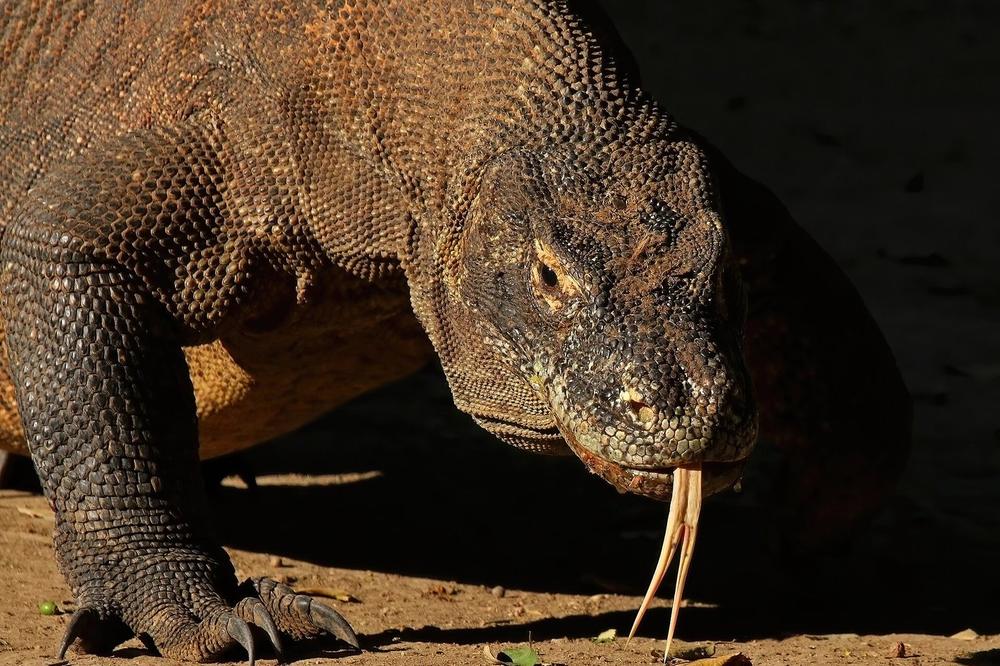
Out of the harbour early on a private boat that is yours for the day, not a seat on somebody else’s. Rinca rather than Komodo island for the first landing: the dragons are the same animal, the walking is more open, and the ranger-to-visitor ratio is better. You walk with two rangers carrying forked sticks, which look absurd until somebody explains that a Komodo dragon can outrun a person over a short distance.
What the photographs never convey is that this is a monsoon savannah, not a jungle. Brown grass, lontar palms, a hard white light. The dragons lie under the ranger kitchen because it smells of food, which is honest and slightly deflating, and the ones worth the trip are the animals you find on the ridge walk half an hour later.
Afternoon on the reef. Snorkelling from the boat at one of the sheltered sites, where the current is manageable and the fish are the point.
Padar on the first session, then Pink Beach
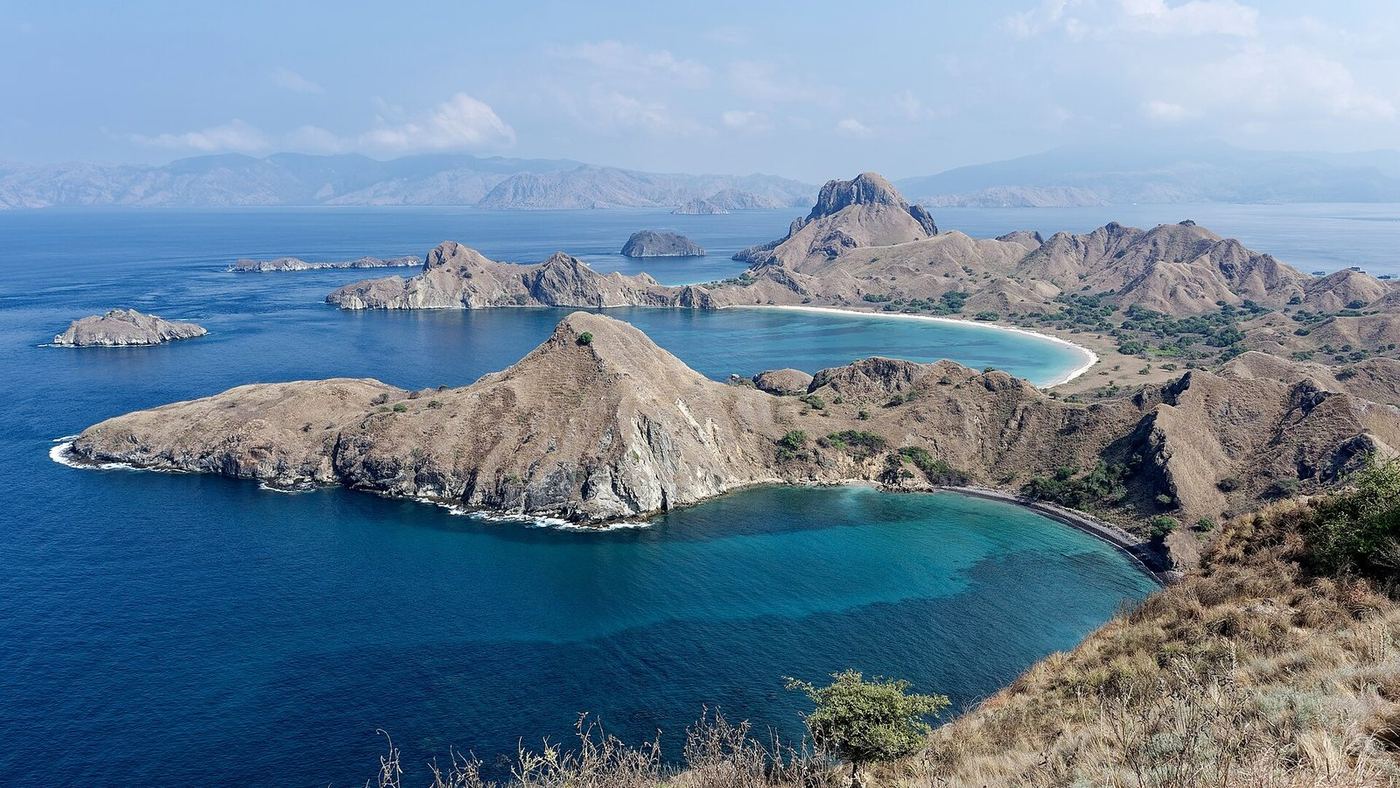
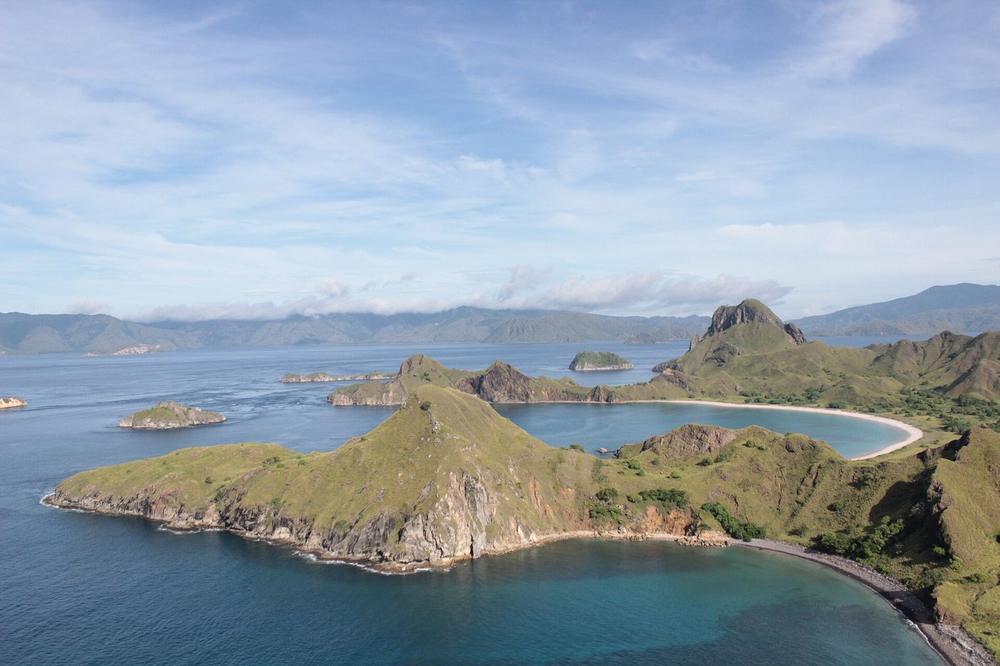
The alarm is uncivilised and the reason is administrative. Our slot on South Padar is the 05:00 to 08:00 session, which means leaving the harbour in the dark and climbing the ridge stair as the light comes up. The climb is a stepped scramble of loose rock to the first saddle and rather more to the top, and what you get is the view that sells Indonesia: three bays cut into one island, each with a different colour of sand.
The 1,000-a-day cap and the three sessions have changed the island completely. Before April 2026 you queued behind two hundred people on a staircase; now the ridge holds a manageable number and the early session holds the fewest of the three. This is the one morning of the journey where the booking system, rather than the weather, decides what you see.
Afterwards, Pink Beach on the way back — the colour is crushed red coral fragments mixed into white sand, and it reads pink in flat light and ordinary at noon — and a second snorkel where the manta cleaning stations are, current permitting.
Flores inland, or the sea again
The spare day of the Flores leg, and it exists because the sea does not take instruction. If either boat day was cut short by swell, today is when we run it again. If both went well, there are two ways to spend it.
Inland: the road east out of Labuan Bajo climbs the whole way and there is no fast section of it. Two to three hours up puts you among the Manggarai villages and the lingko fields near Cancar, where the rice is laid out in a radial pattern like a spider’s web because land was divided outward from a central post. It is the only landscape of its kind in Indonesia and almost nobody on a Komodo trip sees it.
Or the water: a third boat day working the northern sites, which is where the diving is. Certified divers pay the park’s IDR 25,000 daily diving fee on top of the entry; the currents here are strong and site choice is made by the boat captain on the morning, not by us in advance.
Flores to Bali, and east to Sidemen
A short flight west — Labuan Bajo to Denpasar is about an hour and a quarter and several carriers fly it — and then a drive out of the southern sprawl that takes longer than the flight did. That is Bali in one sentence, and it is why this journey does not attempt the south of the island at all.
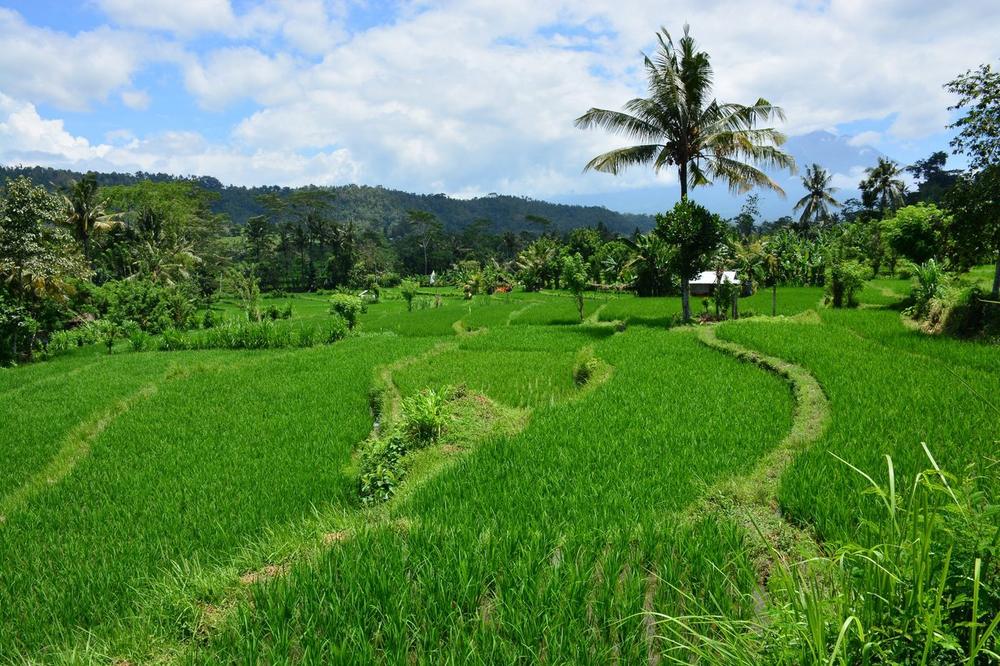
Sidemen sits in a river valley on the south-west flank of Agung, and it is what people imagine when they imagine Bali and then do not book. Rice at every stage of the cycle on terraces cut into both sides of the valley, a road too narrow for coaches, and weaving households making songket on backstrap looms. The first evening is nothing but the view down the valley.
Sidemen on foot
A walking day, and the reason for three nights here. The path system between the villages runs along the irrigation channels rather than the road, which means you walk between farms at the level the water takes, past shrines with fresh offerings on them at seven in the morning, and you meet nobody with a camera.
The irrigation itself is the story. Balinese rice runs on subak, a water-sharing cooperative administered by temples rather than by the state, and it has allocated flow down these valleys for something over a thousand years. Your guide will show you where one subak hands the water to the next, which is a stone sluice and a set of obligations rather than anything that looks like infrastructure.
The east coast, or nothing whatsoever
An unscheduled day, and one thing worth doing with it. Down to the coast at Candidasa and inland again to Tenganan, one of the Bali Aga settlements that were here before the Javanese courts arrived, still walled and still running its own calendar. The cloth woven there is double ikat: warp and weft are both tied and dyed to the finished pattern before a thread is woven, and one piece can occupy a household for years. Only a handful of places on earth still make it.
Or stay in the valley. Sidemen is the only base on this journey with nothing you have to see, and after nine days of moving that is a feature rather than a gap in the programme.
Sidemen to Ubud by the back road
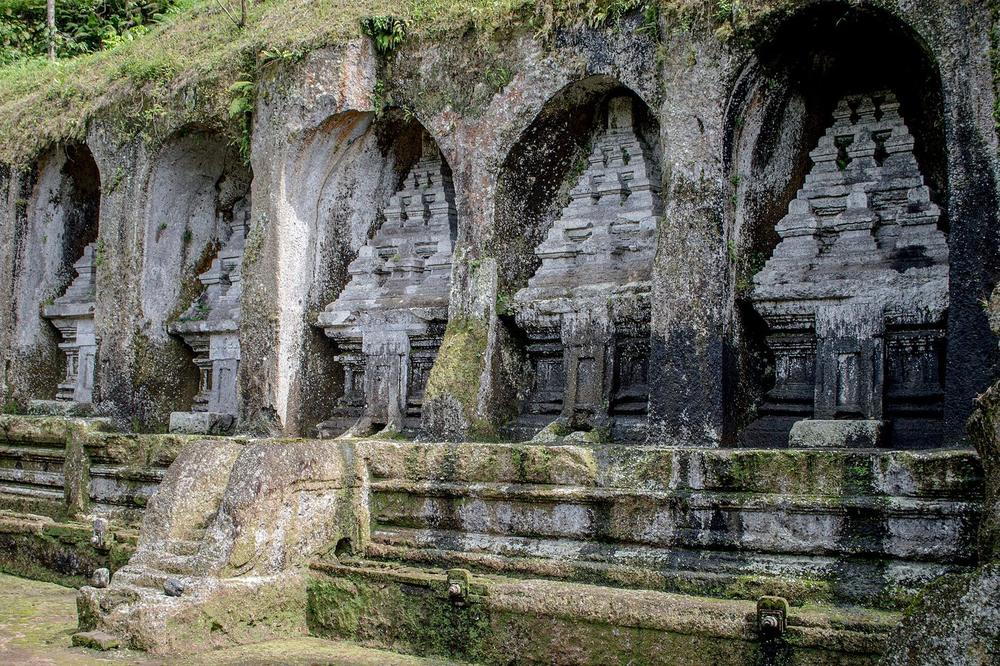
Away by 08:30 and north rather than west, because the direct road is the busy one. The route we use runs up through Bangli and past Gunung Kawi at Tampaksiring, where shrines the height of a house are cut into the rock face on both sides of a river gorge, reached by a long stone staircase. They are eleventh-century and they are carved out of the cliff rather than built against it.
Ubud in the afternoon. It is a market town that became a painters’ colony in the 1930s and then became famous, and the middle of it is now busy enough that we do not put anybody in it — the hotel is in one of the valleys on the edge, where the gamelan carries and the traffic does not.
Ubud: the valley, the painters, the herons
A morning on the Ayung side rather than the Campuhan ridge, which is the walk everybody does. The Ayung gorge path drops through forest to the river and climbs out through a village that still farms, and it is two hours with nobody on it before eight.
The afternoon is what Ubud is actually for. The painting here is not souvenir work: European artists settled in the 1930s, the local schools absorbed perspective and kept their own subject matter, and the results hang in the town’s museums. Then Petulu at dusk, a village north of town where herons come in to roost in the same trees every evening in numbers nobody has bothered to count, and which the villagers regard as an obligation rather than an attraction.
Water, and what is expected of you at it
North to Tirta Empul, a tenth-century spring the Balinese still use for ritual bathing. You may go into the water yourself, sarong on, working along the row of spouts in sequence and behind whoever is already praying at them; you may equally stand on the wall and watch, and that is not the lesser option. Whichever you choose, the guide explains the order before the gate rather than after it.
Temple dress and conduct are set out in a code the province publishes and acts on. People have been deported for ignoring it, more than once and in public. Read that as law rather than as etiquette.
On the way back, the older and emptier sites of the Pejeng valley, where the temples predate the coach circuit by several centuries and hold about four visitors between them.
The flex day
Nothing is planned, and that is the plan. This day exists so that a cancelled flight anywhere in the previous fifteen — ash over Jakarta, weather at Labuan Bajo, an aircraft out of position — can be absorbed without anybody losing a night, and so that you are not connecting internationally on the same day you leave a mountain or an island.
If the journey has run to plan, which it usually does, the day is yours. The suggestions we make are a cooking morning in a family compound, the Ubud market at six when it is still a produce market rather than a craft one, or a legong performance in one of the temple courtyards after dark. Or the pool.
Depart from Bali
Ubud down to Denpasar is a long transfer through the southern sprawl, and the last forty minutes of it swallow whatever margin you thought you had. Ours is generous by design. Please do not hold a seat on anything leaving before midday.
Rooms are held to noon. If your flight is in the evening, the sensible version is a long lunch on the way south rather than four hours in the terminal.
What it costs
| Party size | Comfortable | Considered |
|---|---|---|
| 2 travellers | USD 7,350 | USD 10,000 |
| 3 – 4 | USD 6,100 | USD 8,300 |
| 5 – 8 | USD 5,400 | USD 7,350 |
Where the lowest number comes from: Indonesia sits in tier C on our country table, USD 250 to 360 per person per day for land arrangements, and USD 5,400 over seventeen days is about USD 318 a day. That lands in the upper half of the band rather than the middle, and three things put it there. Chartered boats for three days out of Labuan Bajo, which is a whole vessel and crew for one party. The Komodo park charges, which are per person and per date. And two internal flights booked with real connection buffers rather than the cheapest routing.
Party size then does the rest of the work. Ground transport in Bali is quoted by the day for a car with a driver, roughly USD 35 at the bottom and USD 100 at the top for something like ten hours with fuel and parking in it, and the top of that range is the July-to-September number. Two people carry that vehicle, the chartered boat and three national guides between the two of them; five people divide an identical bill five ways. That, and not the hotels, is why the two-traveller column stands 36 per cent above the five-to-eight one.
Comfortable puts you in the valley outside Ubud, in a good room over the harbour at Labuan Bajo and in a well-run city hotel at Yogyakarta. Considered adds the handful of Balinese properties that are actually worth their rate, a better boat with more deck and fewer people on it, and a water view in Flores. On the caldera it buys nothing whatsoever. The only choice up there is a plain room on the rim or a good one two hours down the mountain, and every grade we sell takes the rim.
Two government charges are deliberately left out of our figure: IDR 500,000 to enter the country for thirty days, and IDR 150,000 a head to enter Bali, the second of which takes no cash. Both are bought by you, directly, so the sum you hand over is the published one and nothing is added to it. Ground costs broken down day by day before margin sit on the prices page, and what each country on this site demands at its border is set out under visas and entry.
What is and is not included
What the price includes
- Sixteen nights as listed, each property named in your quote before you pay anything
- A national guide in Java, a second in Flores and a third in Bali, each with you for their own island
- A private car and driver throughout, and a second vehicle where the party needs it
- Three private boat days out of Labuan Bajo, crew, snorkelling equipment and the ranger fee
- Komodo National Park entry at IDR 700,000 per person per date, the harbour fee at IDR 25,000, and the South Padar timed slot booked in your names
- Bromo national park entry at IDR 220,000 or IDR 320,000, and the dawn jeep
- The two internal flights, the rail leg across Java, and every entrance listed day by day
- Meals as listed, drinking water in the vehicle, and a sarong wherever a temple requires one
What it does not include
- International flights into Yogyakarta and out of Denpasar
- The Indonesian visa on arrival, IDR 500,000 for a 30-day stay and the same again if you renew it
- Bali’s tourist levy, IDR 150,000 a head, payable by card rather than in cash
- Diving in Komodo, the park’s IDR 25,000 daily diving fee, and any equipment beyond mask and snorkel
- Travel insurance, which we require and do not sell
- Meals not listed above, and all drinks
- Tips, which are customary here and never built into our prices
The journey in pictures
Who this journey is wrong for
- Anyone who books late for a peak month. South Padar runs on 1,000 visitors a day across three timed sessions and the slot is tied to a named date. Late bookers in July and August get the 15:00 session or none, and the afternoon light on that ridge is the worst of the three.
- Travellers who are unhappy on small boats. Three of the four Flores days are spent on the water, seven to nine hours at a stretch, and the crossing to Padar in the dark can be lumpy. There is no land-based version of the Komodo leg and we would be selling you a different trip if we pretended otherwise.
- Anyone unwilling to spend two nights in a plain room. Every bed available on that volcanic rim is modest, at any price, and the village is cold. Sleeping somewhere comfortable down the mountain instead means leaving it at three in the morning, twice, and losing the spare dawn that is the reason for the second night.
- People who need a guaranteed same-day international connection out of Denpasar. Ash from Anak Krakatau took 108 Bali flights out of the schedule across 6 and 7 September 2026 and shut Jakarta with them, and some version of that happens somewhere in the archipelago most years. Day 16 exists to absorb it. A tight onward flight throws that protection away.
- Anyone booking the volcano for December, January or February. The wet season on Java and Bali runs November to March and peaks in those three months, and a clear Bromo dawn becomes the exception rather than the rule. The route still operates, eastern Indonesia keeps a different calendar, and you will hear the trade-off from us before you pay a deposit.
How this compares, and what we left out
| Journey | Days | Where | From |
|---|---|---|---|
| Indonesian Archipelago | 17 | Java, Flores, Bali | USD 5,400 |
| Bali and Java | 10 | Yogyakarta, Bromo, Bali | USD 2,900 |
| Philippines and Palawan | 10 | Luzon, Palawan | USD 3,200 |
| Borneo and Sabah | 9 | Sabah | USD 3,400 |
The ten-day route covers the same two Javanese temples and the same caldera, then gives Bali to Ubud and the east coast. This one adds Flores and takes Bali east and inland instead, to Sidemen. Anybody who has done the short version and wants the long one is therefore not repeating a week of it, which is deliberate.
What we left out and why. Sulawesi, because the Toraja funerary country deserves four nights of its own and adding it costs two more flights. Sumatra, for the same arithmetic. Raja Ampat, because it is a separate journey: the marine park permit alone is IDR 700,000 and valid twelve months, the settled diving window is roughly October to April, and reaching it eats three days at each end. One clarification there, since the two get confused: highland and central Papua carry do-not-travel and reconsider-travel advice and we will not send anybody there, while coastal Raja Ampat, in West Papua province, sits outside those warnings entirely and is a normal commercial diving destination. Different places, several hundred kilometres apart.
For the island rather than the route, read Ubud and Bali; for the country and which of its seasons applies to which island group, Indonesia and when to go.
Start with the month
Tell us when, how many of you there are, and which half of this — the sea or the stonework — is the reason you are going. For a July or August departure inside four months, our first reply will say what the Padar sessions look like, because that decides the shape of the whole Flores week.
Questions travellers ask most
What exactly changed at Padar, and how does it affect our booking?
Komodo National Park now caps the South Padar visitor area at 1,000 people a day, split into three timed entry sessions — 05:00 to 08:00, 08:00 to 11:00 and 15:00 to 18:00 — allocated through the park’s SiORA system. It was trialled from October 2025 and has been enforced since April 2026.
In practice it means the Padar morning is booked into your itinerary against a named date, months ahead, rather than bought at the jetty. It also means a missed session cannot simply be repeated the next morning if the next morning is full. That is why we hold four nights in Labuan Bajo and keep one of them unscheduled.
Is a volcano going to cancel this trip?
The risk lands on aircraft rather than on the itinerary. Anak Krakatau put 108 Bali-linked flights into disruption over 6 and 7 September 2026 and held Jakarta’s airports shut until 08:59 on the second morning; Denpasar itself never closed. Mount Lewotobi Laki-Laki, at the far eastern end of Flores, remains at elevated alert with a 7 km exclusion zone around the crater, several hundred kilometres from anywhere this route goes.
Our answer is structural: the flex day on day 16, nothing connecting internationally on the day you leave Bali, refundable rates on the Balinese nights wherever a property will write them, and a reading of the official volcano monitoring service in the week before departure rather than on the morning of it. If ash grounds an aircraft we re-plan, and this is precisely what your insurance is for.
What do we have to pay the Indonesian government, and when?
Two charges. Neither is inside our price and both are paid by you directly, so the figure you pay is the published one. No American, British, EU or Australian passport appears on Indonesia’s visa-free list, which means everybody on this journey buys the electronic visa on arrival: IDR 500,000, good for 30 days, renewable once at the same price for a further 30.
Bali charges separately. IDR 150,000 a person, paid once, covering the whole stay rather than any particular site, and no cash is accepted — card, transfer, virtual account or QRIS, through the provincial system online or at a counter on arrival. Your documents pack carries the two official addresses, because the middlemen who add a handling fee rank higher in search than the government does.
Could we add Raja Ampat or Sulawesi to the end?
You can, and it is a separate week rather than an extension. Raja Ampat costs roughly three days of travel at each end from Bali, its settled diving window is about October to April, and the marine park permit is IDR 700,000, valid twelve months. Sulawesi is the same arithmetic for a different reward.
One thing worth saying plainly because the names get confused: the do-not-travel and reconsider-travel advice for Papua applies to the highland and central provinces, not to coastal Raja Ampat in West Papua province, which sits outside those warnings and operates as a normal diving destination. We will not route anybody into the highlands under any grade of service.
Read next
Tell us about the journey you have in mind
Dates, party size and the places you care about are enough to start. You get a draft route and an indicative price, not a brochure.