Two Arab countries, fifteen nights, one flight between them
Eight nights of Jordanian archaeology, one flight across the peninsula, and seven nights of Omani rock, dune and coast. The two halves of Arabia that do not resemble each other.
At a glance
As at September 2026 the United States has Jordan and Oman both at Level 3, Reconsider Travel. The trigger in each case is the same: the US–Iran conflict that began on 28 February 2026 and the drone, missile and airspace risk that has followed it across the region. Jordan's do-not-travel zones are the Syrian and Iraqi border areas and a short list of named neighbourhoods; Oman's is the Yemen border. Nothing on this itinerary enters any of them.
The United Kingdom takes a narrower view of Jordan. On 3 June 2026 the Foreign Office lifted the blanket warning it had placed over all non-essential travel there; what remains is a 3 km band along the Syrian frontier, plus a standing caution that strikes elsewhere in the region and short-notice flight disruption are both still possible.
Those are the advisories as published. We are not going to interpret them for you, talk you past them, or tell you which risk is yours to accept. What we will tell you is our side of it: this voyage is quoted on flexible cancellation terms throughout, the deposit can be moved to a different month or a different part of Asia up to 45 days before departure, a stood-down departure is refunded rather than credited, and we do not operate a journey we would not put our own families on. Check your insurance wording rather than its summary page, because several underwriters now treat this region differently. Our fuller account of what the advisory tiers mean, and what we decline to sell at all, is on safety and advisories.
- Duration
- 16 days, 15 nights
- Party
- Private, 2 to 8
- Starts
- Amman
- Ends
- Muscat
- Difficulty
- Moderate, Petra is walked
- From
- USD 6,300
Jordan and Oman get sold together because they are both Arab, both safe to drive and both roughly a fortnight apart on a route map. That is not the reason to put them in one journey. The reason is that they answer different questions. Jordan is what people built and left behind: Nabataean, Roman, Crusader, Byzantine, one layer on top of another down a single north-to-south spine. Oman built very little that survives above head height and has instead the thing Jordan lacks entirely — scale of landscape, and a coastline.
Sixteen days is what it takes to see that difference rather than be told about it. Eight nights in Jordan is enough to give Petra three days instead of one, which changes what Petra is. Seven nights in Oman is enough to go up into the Hajar mountains, out into the sand and back along the coast without a single internal flight.
One flight sits in the middle, on day nine, and it is the only air leg in the journey. Everything either side of it is driven, and there is no backtracking in either country.
Day by day
The pass comes in three tiers and the only difference between them is how many days at Petra they carry: Wanderer 70 JOD for one, Explorer 75 JOD for two, Expert 80 JOD for three. All of them cover more than forty other sites and all of them include the tourist entry visa — provided the pass is bought before you land and you spend at least three nights in the country. This voyage spends eight, so the condition is met with room to spare.
We buy the Expert tier because the itinerary uses a Petra ticket on three separate days. Priced individually at September 2026 rates, the sites on this Jordanian leg come to 110 JOD — Petra at 60 for three days, Jerash 12, Bethany Beyond the Jordan 12, Wadi Rum 5, Umm Qais 5, Ajloun 3, Mount Nebo 3, the Madaba archaeological park 3, the Amman Citadel 3, the Roman theatre 2 and Karak 2 — before the visa fee is counted at all. Petra by Night is the one thing the pass will not open; it is ticketed separately even for holders, and we book it if your dates land on an evening it runs.
Arrive Amman
You are met inside Queen Alia and driven up into the city, half an hour or so depending on the hour. Nothing else is planned for day one and nothing should be.
Amman is seven hills that became twenty-odd, built in pale limestone, and it is a great deal more ordinary than the brochures for this region suggest. That is worth something. You are starting in a working capital rather than in a monument.
The Roman north: Jerash, Ajloun and Umm Qais
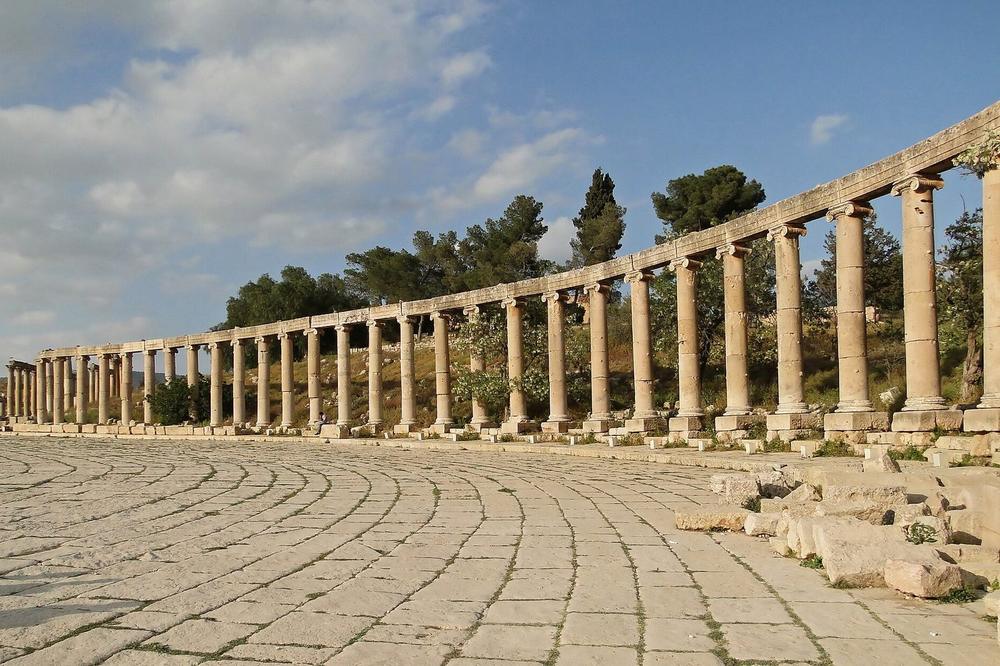
A full day north, which most Jordan itineraries reduce to a morning at Jerash and a drive back. Jerash first, entry 12 JOD, and early: an oval plaza, a colonnaded street with cart ruts worn into the slabs, two theatres and a hippodrome, all of it laid out clearly enough that you can read the town plan as you walk it.
Then Ajloun, 3 JOD, a Muslim castle built to watch the Crusader ones, and Umm Qais, 5 JOD, which sits on a bluff at the top corner of the country. From its basalt colonnade you look down on the Sea of Galilee, across at the Golan and along the Yarmouk valley. Standing there explains Jordan's neighbourhood faster than any briefing.
Amman, Madaba and Mount Nebo, then down to the Dead Sea
The morning belongs to the city. The Citadel, 3 JOD, is one flat hilltop on which an Iron Age wall, a Roman temple and an Umayyad audience hall all sit within sight of each other, and below it is the theatre the Romans quarried straight into the hillside, 2 JOD.
South after lunch to Madaba, whose sixth-century floor mosaic is the oldest surviving map of the Holy Land and is still, unhelpfully for map readers, oriented east. The archaeological park is 3 JOD. Mount Nebo, 3 JOD, is twenty minutes further and looks west over the Jordan valley; the view is either enormous or entirely absent, depending on haze, and nobody can promise which.
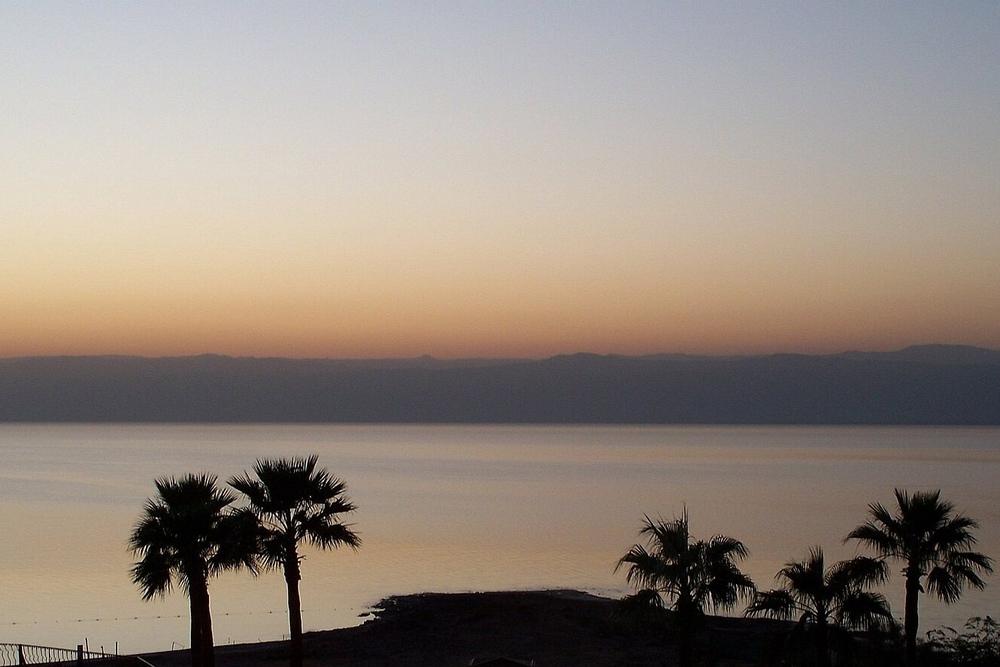
The road then falls for the better part of an hour to the lowest exposed land on the planet. The shore itself is parcelled out among hotels rather than held as a public beach, and their day rates for non-residents sit somewhere between 25 and 65 JOD depending on the property. Sleeping there removes the question entirely, which is why we do.
Bethany, the King's Highway and Karak, to Dana
Bethany Beyond the Jordan first, 12 JOD, on the river itself: the baptism site agreed by most archaeologists and by the Vatican, a set of low Byzantine foundations and a river narrow enough to throw a stone across into the West Bank. It is a border zone as much as a pilgrimage site and it is visited with a site guide, on a fixed path.
Then south on the old King's Highway rather than the fast desert road. The highway costs two hours and buys the Wadi Mujib canyon, which it crosses by dropping a thousand metres in hairpins and climbing straight back out, and Karak castle, 2 JOD, a Crusader keep on a spur with galleries you need a torch for.
Dana is the last hour. The village is stone and mud-brick on the lip of a wadi that drops away west towards the rift valley, and the reserve behind it runs from that lip down through four biological zones. There is no nightlife, the heating is unreliable in winter, and the silence at the edge of the terrace is the reason to stop here rather than push on to Petra.
Dana to Wadi Musa, and the Siq at the end of the day
A walk before breakfast on the rim path, an hour and a half out and back, with the wadi filling with light below you and, in spring, ibex on the opposite slope if the guide is lucky. Longer descents into the reserve exist and are a full day; say so at the enquiry stage and we build the day around it instead.
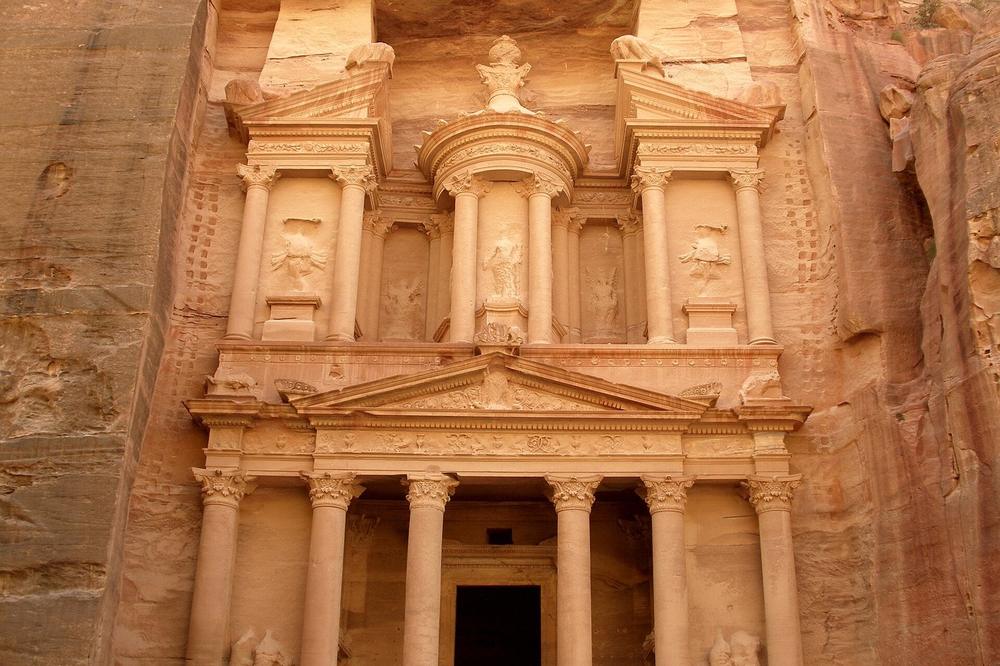
Wadi Musa is an easy drive south and we arrive in the early afternoon on purpose. The first Petra day starts at about three, when the coach parties are coming out and the light in the Siq has gone long and orange. The Siq is a fault the water widened, not a corridor anybody cut, and it twists for something close to a kilometre before the Treasury appears in a vertical slot at the end. Meeting it first with almost nobody there is a deliberate choice and it costs nothing except an early start tomorrow.
Petra, the whole city
At the gate for opening, and past the Treasury without stopping, because you stopped yesterday. Past the Street of Facades, past a theatre quarried out of the cliff rather than built against it, and up to the Royal Tombs, whose banded reds and greys defeat every camera ever pointed at them.
The middle of the day goes to the flat centre of the site: the colonnaded street, the Great Temple, the Byzantine church with its floor mosaics under a shelter. Petra is several square kilometres of city, not a single facade, and this is the day that makes that obvious. Lunch is inside the site, out of the sun.
Petra, the third day: the Monastery and the High Place
The stair to Ad Deir is roughly 800 rock-cut steps up the back of the city, and Ad Deir at the top is bigger than the Treasury and usually has a fraction of the audience. You will be offered a donkey on the way up. Please decline: those animals go up and down that stair all day in the heat, and paying more for the ride does not change it.
Legs permitting, the other half of the day is the High Place of Sacrifice on the far side of the valley, walked up one way and down through Wadi Farasa the other, which passes tombs almost nobody sees. Anyone who has had enough of stairs takes the Petra museum and the Little Petra siq at Siq al-Barid instead, twenty minutes out of town, which is a genuinely good afternoon rather than a consolation.
Petra to Wadi Rum
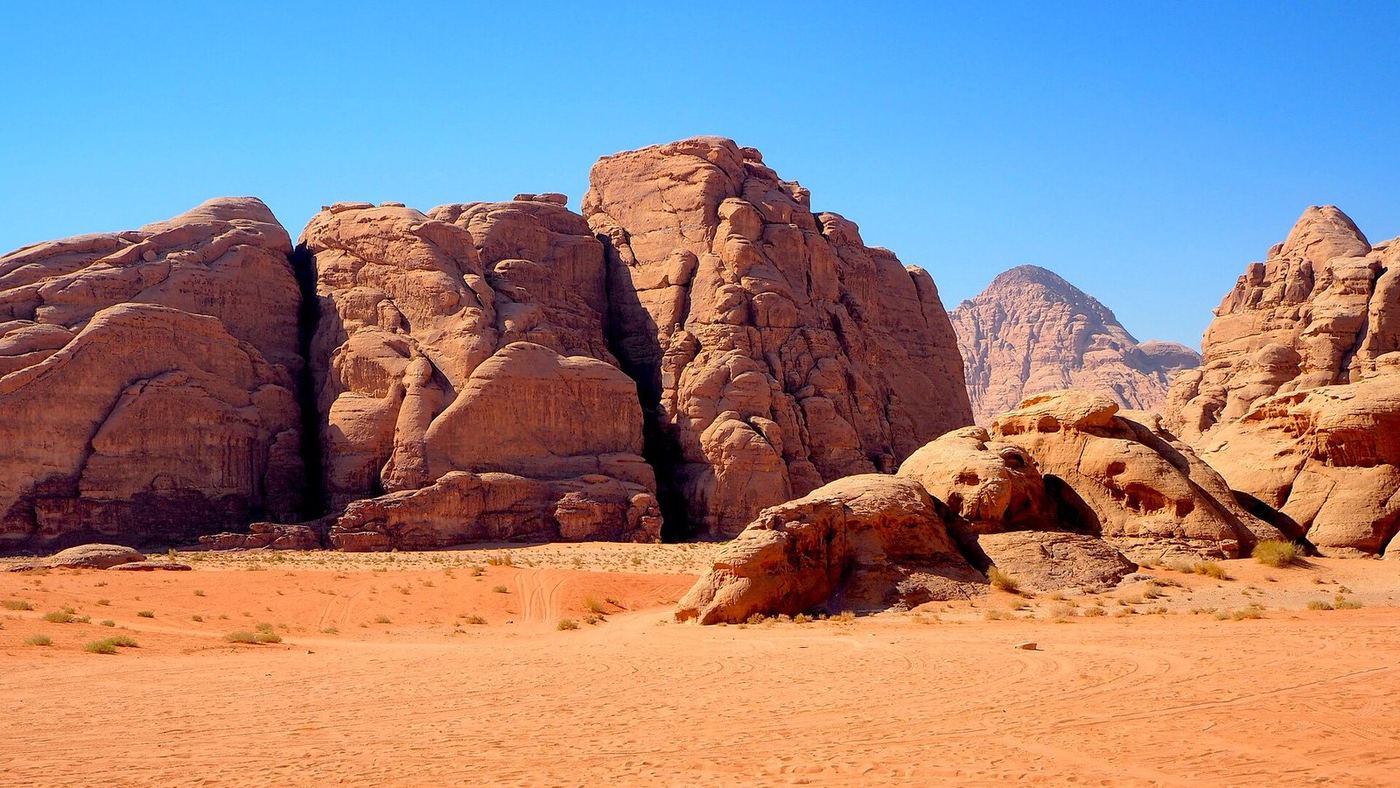
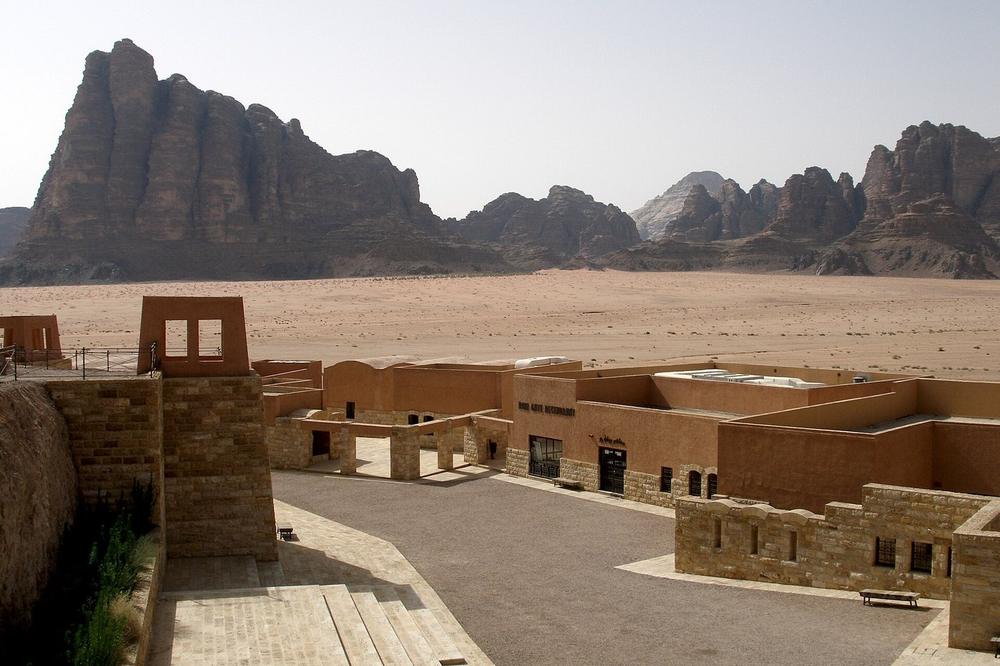
South in the morning to Wadi Rum. Entry to the protected area is 5 JOD, and the road vehicle goes no further than the village; a Bedouin driver and an open pickup take it from there. The afternoon runs among sandstone and granite towers standing out of red sand, past rock inscriptions left by people who came through two thousand years before anything was carved at Petra.
The camp is inside the protected area rather than on the edge of it, and the reason for that is the sky. There is no settlement near enough to put light into it, and on a moonless night the difference is not subtle. Winter nights here go below freezing; the tents are heated and that is not the same as warm.
Wadi Rum to Muscat
The transit day, and the one day of the sixteen with no sightseeing in it. Out of the desert after breakfast and down to Aqaba, where the short hop north to Amman saves four hours of desert highway, then the onward connection to Muscat through a Gulf hub.
We build this day with a long layover rather than the tightest connection the airline will sell, and we do it for a specific reason: Gulf airspace has closed at short notice more than once in 2026, and the ninety-minute connection is the one that leaves you sleeping in a terminal. You land in Muscat in the evening and the transfer is waiting whatever time that turns out to be.
Muscat
The Sultan Qaboos Grand Mosque admits non-Muslim visitors during a set morning window that ends before the midday prayer. We check the hours in force during the week you fly instead of printing a time on a page that could be a year old. Covered arms and legs, a scarf for women, shoes left at the door.
Afterwards Bait Al Zubair, a private family museum which is the best hour you can spend on Omani history before you go inland, then the Mutrah souq, which sells frankincense and silver to visitors along one aisle and everything else to Muscat down the others. Old Muscat last: the palace sits in a notch in the cliffs with a Portuguese fort on either side, both of them army property and neither open to anyone.
Muscat to the Saiq plateau
Inland through the break in the Hajar range, and a stop at Birkat al Mawz where a falaj — one of the open water channels that have carried the mountain's supply down to the date gardens for centuries, on a rota the villages police among themselves — runs out of the rock into the plantation.
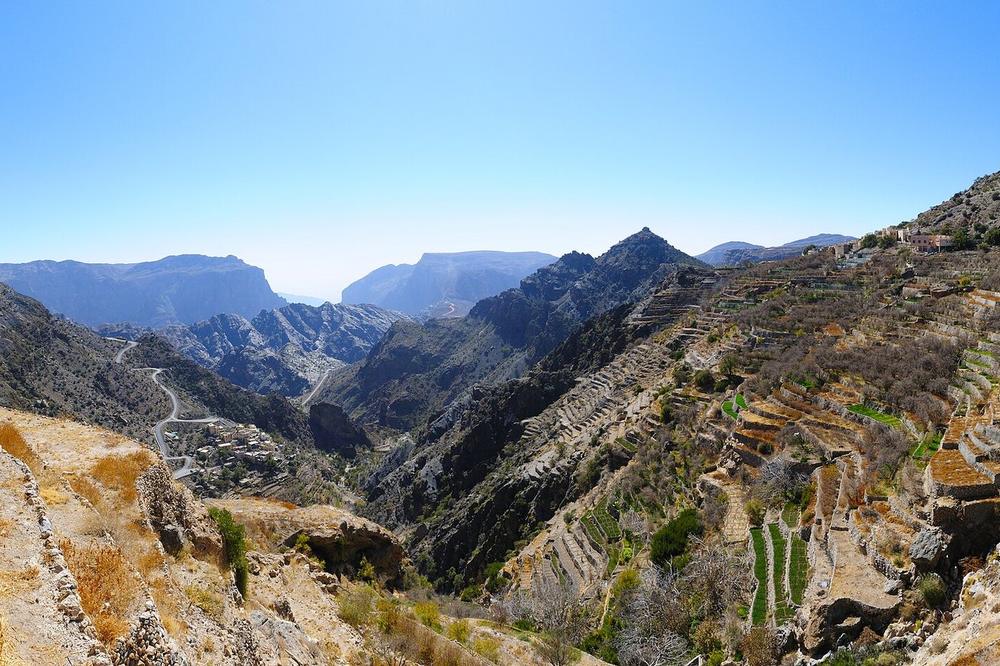
Then the ascent. The climb onto the Jebel Akhdar does almost all of its work in a twenty-minute stack of hairpins, and a police post at the foot of it turns back anything without four-wheel drive. At the top the temperature has dropped: the plateau holds roughly 18 to 26°C while the interior bakes below it. That gap is why these slopes have been terraced for longer than anyone can date the channels that water them.
The terrace villages, on foot
The morning is the walk that justifies sleeping up here. The route from Al Aqr through Ash Sharayjah to Al Ayn is a stone path laid beside the water channel, dropping from one hamlet to the next on the contour, with pomegranate and walnut on the terraces below the line of the water and bare rock above it. Damask roses are planted through those terraces, and they flower and are distilled in spring. The rest of the year the terraces are there and the flowers are not, whatever the brochure photograph shows.
The afternoon goes to Wadi Bani Habib, across a walnut grove and down a flight of steps to a village of roofless mud-brick houses abandoned within living memory when the families moved up to the road. The climb back out is the only real work of the day.
Down to Nizwa, and east to the Sharqiya Sands
Off the mountain and into Nizwa, which governed the Omani interior when the interior and the coast were separately ruled. Its fort is built around an enormous round tower designed to survive exactly that argument, and the souq against its wall still trades dates, silver and copper on the ground floor rather than in a heritage display.
Then the long leg east: roughly 230 km and three hours from Nizwa to the edge of the dunes at Bidiyah. There is no reserve gate and no entrance fee for the Sharqiya Sands, because access runs through the camps rather than through a government barrier. You leave the road, the camp's 4x4 takes you over the first ridges, and the traffic noise stops within a couple of kilometres.
Out of the dunes to the turtle coast
East out of the dunes to Wadi Bani Khalid, where a stream that never dries comes out of a limestone gorge into a run of green pools. Weekday mornings are quiet and Friday is not; the rock at the waterline is polished and slick, so wear something with a grip on it.
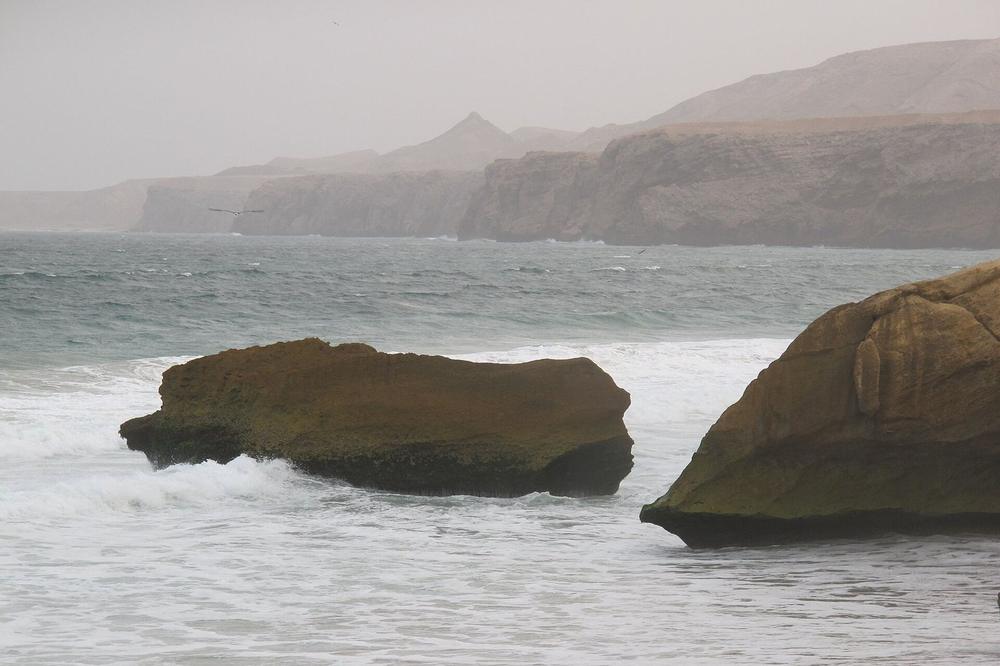
On east through Sur. It is 174 km from the dunes and takes about two and a half hours, and Ras al Jinz is a further stretch of coast beyond it. Green turtles come up onto that beach to nest on every night of the year. The reserve's night walk starts at 21:00 with arrival by 20:30, and tickets are 12 OMR for an adult and 6 OMR for a child aged 6 to 12, booked ahead. This is a research station that lets visitors in, not an attraction built for them: rangers decide where you stand and how much light there is, no flash goes near a nesting animal, and some nights hand you two turtles and some a dozen.
Ras al Jinz to Muscat by the coast road
The dawn viewing runs from 05:00 with arrival by 04:45 and is a separate ticket, and about half our travellers take it. A turtle heading back down the sand in early light is a great deal easier to follow than one hauling up it at midnight. Breakfast at the centre either way.
Sur next, briefly: two yards there still lay down ocean-going dhows from memory rather than from plans, the hull that once carried Omani trade south to Zanzibar and east to Malabar. Then the coast road north, which is the best driving in the country. Wadi Shab is the stop that matters. A boatman takes you the forty metres across the mouth of it against a small cash fare, and then the walking starts: roughly an hour upstream over boulders and between palms to a string of pools, with the last chamber reachable only by swimming through a slot in the rock. You are back on the Muscat coast by mid-afternoon.
Depart Muscat
Breakfast, then the run out to the airport, which takes half an hour or a little more once the coast road is allowed for. A late departure gets a day room; nobody finishes this journey sitting in a lobby beside their suitcase.
What it costs
| Party size | Comfortable | Considered |
|---|---|---|
| 2 travellers | USD 8,550 | USD 11,650 |
| 3 – 4 | USD 7,100 | USD 9,650 |
| 5 – 8 | USD 6,300 | USD 8,550 |
The gap between the columns is a vehicle and a guide, not a room. Jordan is covered by a driver-guide whose multi-day rate on the Petra and Wadi Rum circuit runs roughly 92 to 113 JOD a day depending on vehicle and season, and Oman by a 4WD and an Omani guide for the whole seven nights. Both of those are party costs, divided by however many people are in the car, so two travellers each carry about 36% more than a party of five on an identical route.
Comfortable means well-run four-star hotels in Amman and Muscat, a Dead Sea property with its own shore, the rim guesthouse at Dana, somewhere in Wadi Musa you can walk to the gate from, a tent of your own with plumbing in Wadi Rum and another in the Sharqiya, and the plateau hotels on the Jebel Akhdar. Considered takes the best addresses on the Dead Sea shore, at Petra and in Muscat, plus the cliff-edge places above the Jebel Akhdar canyon, which are genuinely better and priced as though they know it.
Two places take the same room in either grade, and we would rather say so than let you find out. Ras al Jinz has one place to sleep and it belongs to the reserve. Dana has a handful of small guesthouses and none of them is a five-star anything. The prices page takes a day rate apart into hotel, vehicle, guide, entries and margin, country by country.
What is and is not included
What the price includes
- Fifteen nights, each hotel or camp named in the quote before you pay anything
- The Jordan Pass at the Expert tier, 80 JOD, covering three Petra days and waiving the entry visa fee
- A private car and a Jordanian driver-guide who speaks English, for all eight Jordanian nights
- A private 4WD and an Omani driver-guide for all seven Omani nights
- The two flights on day 9, Aqaba to Amman and Amman to Muscat via a Gulf hub
- The Bedouin-driven pickup afternoon in Wadi Rum, and the night at the camp
- The 4x4 transfer in and out of the Sharqiya dunes
- Ras al Jinz night viewing at 12 OMR an adult, booked ahead
- Every entrance named above, and drinking water in both vehicles
- A phone number in each country that a person picks up after dark, for all sixteen days
What it does not include
- Your flights into Amman and home out of Muscat
- Travel insurance. We insist on it, we do not sell it, and we ask you to confirm the policy still pays out where a Level 3 advisory is in force
- Oman entry, which is free for up to 14 days on most Western passports and therefore costs nothing on a seven-night stay
- Petra by Night, which is ticketed outside the pass
- The dawn turtle viewing on day 15, ticketed separately from the night walk
- Dead Sea and hotel spa treatments, and any diving
- The full-day descent into the Dana reserve, if you take it instead of the rim walk
- The Wadi Shab boatman, who takes cash at the water
- Meals not listed day by day, all drinks, and tips
The journey in pictures
Who this journey is wrong for
- Anyone who does not want an elevated advisory in the decision. Both countries sit at US Level 3 as at September 2026 and the UK notes continuing regional risk in Jordan. If you would spend the trip refreshing a news page, the honest answer is a different region this year, and we will say so on the phone.
- Travellers who cannot cover ten kilometres or more on foot three days running. Petra has no vehicle access past the gate, days 6 and 7 are long, and the Monastery stair is about 800 steps. Days 5 to 7 are the spine of the Jordanian half and there is no soft version of them.
- Anyone whose dates fall between June and August. The Omani interior goes past 38°C and stays there, the Dead Sea shore reaches 40, and daytime Wadi Rum sits near 34. Neither country is quoted for those three months on this route, whatever the budget.
- Anyone who wants the Red Sea. There is no Aqaba night here — day 9 goes straight from the desert to the airport — and Oman's coast is compressed into a single driving day. If diving or a stretch of beach is part of the point, the nine-day Jordan journey ends at Aqaba and the ten-day Oman loop gives the coast two days instead of one.
- Anyone who has already done one of these two countries. This voyage takes the obvious spine of each. It does not include the Jebel Shams canyon rim, Salalah, the Jordanian desert castles or the Wadi Mujib water trail, and someone returning to Jordan or Oman is better served by a route built around what they missed — which is what tailor-made is for.
How this compares
| Journey | Days | Countries | From |
|---|---|---|---|
| Jordan and Oman | 16 | Jordan, Oman | USD 6,300 |
| Jordan | 9 | Jordan | USD 3,300 |
| Oman | 10 | Oman | USD 3,900 |
| Silk Road | 16 | Uzbekistan, Kyrgyzstan | USD 4,600 |
| Georgia and Armenia | 11 | Georgia, Armenia | USD 3,100 |
The two country journeys bought separately come to nineteen days and rather more money than this one, and they include an Aqaba night, the Jebel Shams rim and a second day on the Omani coast that the voyage does not. The voyage buys the third Petra day, the north of Jordan and Dana, and it does the whole thing on one ticket with one operator either side of a single flight. Which of those is the better purchase depends entirely on whether you would rather see more of two countries or all of one.
If the elevated advisories are the sticking point rather than the itinerary, the sixteen-day Silk Road is the same length in a region the same governments currently rate at Level 1. What Petra is actually like on a multi-day ticket is set out on the Petra page, and the month-by-month picture for both countries is on when to go.
Tell us your month
Two lines will do: when you want to travel and how many of you there are. A draft comes back inside two working days, and it will restate where both advisories stand in the week you read it, not where they stood the day this page was built.
Questions travellers ask most
Both countries are at Level 3. What does that mean for a booking?
As at September 2026 the US State Department asks travellers to reconsider travel to Jordan and to Oman, in both cases because of the US–Iran conflict that began on 28 February 2026 and the drone, missile and airspace risk that has run on from it. The do-not-travel zones are the Syrian and Iraqi border areas and a handful of named Jordanian neighbourhoods, and the Yemen border in Oman. This route enters none of them. The British position on Jordan has been narrower since 3 June 2026, when the blanket warning came off and was replaced by a 3 km exclusion along the Syrian frontier.
We will not tell you the advisory is overstated and we will not tell you what risk your family should accept. Both of those are yours and your insurer's. Our commitments are the ones we can keep: flexible cancellation terms across the whole voyage, a deposit that stays movable until 45 days before you fly, and money back rather than a credit note if we cancel a departure ourselves. We also hold to one internal test, which is that nothing goes out that we would not put our own people on.
Two practical points. Read the policy wording rather than its summary, because some underwriters now price or exclude this region against government advice. And give any connection you cannot afford to miss a spare day, because the region's airspace has closed with little warning several times this year.
Which Jordan Pass do we need, and do we need an Omani visa?
The Expert tier at 80 JOD, because this itinerary walks into Petra on three separate days. Wanderer at 70 covers one Petra day and Explorer at 75 covers two. Each tier also carries the tourist entry visa and admission to more than forty sites, and a pass stays live for three months from the day you enter.
One condition trips up short stays: the pass has to be paid for before you land, and the visit has to run to three nights or more. Eight nights clears that without anyone having to think about it. The pass is in your price either way, because it costs less than the tickets it replaces.
Oman needs nothing at all on this journey. Most Western passports enter free of charge for up to 14 days and this leg is seven nights. If you are adding days at the Muscat end and will pass 14, the e-visa applies, filed with the Royal Oman Police. It asks for six months left on the passport, a return or onward ticket, a confirmed booking, insurance and proof you can pay for yourself — so raise it with the enquiry rather than once a quote is on the table.
Which months actually work for both countries at once?
October, November and March, and the overlap is genuinely that narrow. Jordan is at its best from March to May and again in October and November, roughly 18 to 28 degrees. Oman's window is October to March. Put the two together and you get three months where neither country is compromised, with October the one most people who work in the region would pick.
December to February is a real alternative if you pack for it. Oman is close to perfect and Jordan is cold: January in Amman averages about 12 degrees, Petra takes snow in some winters, and the Wadi Rum night goes below zero. An empty Petra under a clear winter sky is an argument in itself.
June to August is out, for the temperatures set out above, and we do not quote this route in those months. One calendar note for early 2027: Ramadan should start on or about 8 February and Eid al-Fitr falls in the first days of March. Sites do not close and hotel restaurants keep normal service; what shifts is public daytime eating, a few opening hours, and a heavy domestic travel week over Eid in both countries.
Why only one flight, and what happens if it is cancelled?
Because everything else on this route is within a driving day of the last thing. Jordan is a single north-to-south corridor and Oman is a circle drawn round Muscat; neither shape needs an internal flight, and adding one buys nothing but a morning lost at an airport. The single air leg is the crossing between them on day 9, which no amount of route planning can avoid.
We book it as one ticket rather than two separate ones, which matters: a delay out of Aqaba then becomes the airline's problem to re-route rather than yours to re-buy. The Muscat arrival day carries no scheduled sightseeing precisely so that it can absorb a delay, and if the crossing is lost entirely we move the Muscat city day to the end of the Omani leg and shorten the coast day rather than cutting the Jebel Akhdar, which is the part that cannot be done in a morning.
This is also why the Jordan leg comes first. A voyage that started in Oman would put the flight risk in front of Petra, and Petra is the one thing on this itinerary that nobody would accept losing.
Read next
Tell us about the journey you have in mind
Dates, party size and the places you care about are enough to start. You get a draft route and an indicative price, not a brochure.