Two countries, one narrow window, eighteen nights
The dry-zone capitals and the hill railway, then an hour in the air to a Kerala coast that shares Sri Lanka’s rain and none of its geography. The reason this pairing works in February and fails in July is the whole argument of the route.
At a glance
- Duration
- 19 days, 18 nights
- Party
- Private, 2 to 8
- Starts
- Colombo
- Ends
- Kochi
- Difficulty
- Easy to moderate, two climbs
- From
- USD 5,900
Sri Lanka and Kerala are an hour or so apart by air and sold as a pair by almost every operator who sells either. The pairing is right. What is usually left out is the reason it is only right in some months, which is that the same body of monsoon air crosses both, and one of the two has somewhere to hide from it while the other does not.
Eighteen nights is enough to take Sri Lanka in the order the island was actually built — the dry-zone capitals first, then the kingdom that retreated into the hills, then the coast the Europeans took — and still have a week on the Malabar side of India afterwards without turning it into an airport-to-beach transfer.
Eleven of those nights are Sri Lankan and seven are Indian, and the split is deliberate rather than arithmetic. Sri Lanka has more to see per kilometre than almost anywhere in Asia and takes three times as long to cross as the map suggests. Kerala has fewer sights and rewards stopping; the last four nights of this journey have a boat, a lake and a beach in them and nothing that opens at nine.
The monsoon logic, which is the reason this route exists
Two rain systems cross Sri Lanka on opposite schedules. The Yala, or southwest, monsoon soaks the western and southern seaboard between May and September, leaving January to March as the dry stretch there. The Maha, or northeast, monsoon works the far side of the island from October to January with November and December the wettest of it, so Trincomalee and Arugam Bay dry out from June to August. The hill country in the middle — Kandy, the tea belt, Ella — catches rain off both systems and has no sharply defined dry window at all.
That is why a Sri Lanka journey can be sold in any month of the year. Ask for July and a competent operator does not argue; they move you from Galle to Trincomalee and run the same triangle and the same train.
Kerala cannot do that, and this is the fact the pairing turns on. The Indian monsoon makes landfall on the Kerala coast before it reaches anywhere else in the country and stays broadly from June to September; the classic touring window is October to March and the driest weeks are December to February. Kerala has one coast. There is no eastern shore to move you to, because the eastern shore of that peninsula is Tamil Nadu and a different journey.
Put the two together and the overlap is narrow and obvious: January to March, when Sri Lanka’s southwest coast is dry and Kerala is in the middle of its own dry season. December works and is the busier, wetter end of it. October and November are the in-between months — the southwest monsoon has left the coast this route uses, the northeast one is landing on the far side of the island, and Kerala is drying out. It runs. It is not the pick.
From June to September we will not sell this journey at all, and the reason is not squeamishness about rain. The single flip that saves a Sri Lanka trip in those months — go east — also puts the Indian half in the worst four weeks of its year, so the fix for one country breaks the other. If July is the only month you have, take the eleven-day Sri Lanka journey run to the east coast and leave Kerala for another year. The full month-by-month picture across Asia is on when to go.
Day by day
On 25 May 2026 Sri Lanka stopped charging for the ETA across 40 nationalities — American, British, Australian and the EU states on the published list included. Thirty days, double entry, no fee. What it is not is visa-free: the form is still filed online and cleared before you board. Passengers under 12 have been given the 30-day ETA free of charge whatever the passport, right through the fee turbulence of 2024 and 2025.
India is the half that costs money. On the e-Tourist visa an arrival between July and March is USD 25 and one between April and June is USD 10, with a 3% bank charge on either and a higher reciprocal figure for British passports. Applications open 120 days out, close four days before arrival, and are usually answered inside about 72 hours. This route lands in the USD 25 band, and the version you need is the 30-day one rather than the year.
The Colombo to Kochi leg on day 12 is an international flight and we book it with a wide margin rather than the shortest connection available. Your Sri Lankan driver takes you to the airport; a different guide and a different car meet you on the Indian side.
Arrive Colombo, sleep at Negombo
The airport sits north of the capital and closer to Negombo than to Colombo, so the first night goes to Negombo and saves an hour of city traffic at both ends of a long flight. Most arrivals off a Gulf connection land between two and five in the morning.
Nothing is scheduled. If you land in daylight, the walk worth taking is the fish market and the Dutch canal at the north end of the lagoon, where the oruwa outriggers come in and the catch is auctioned on the sand in about fifteen minutes flat.
North to Anuradhapura
Away by eight, north out of the wet zone. The vegetation changes twice on this drive: coconut gives way to paddy, paddy to scrub jungle, and then the tanks begin — artificial reservoirs, some of them two thousand years old and still irrigating, which are the reason a civilisation of this size ever stood in a landscape this dry.
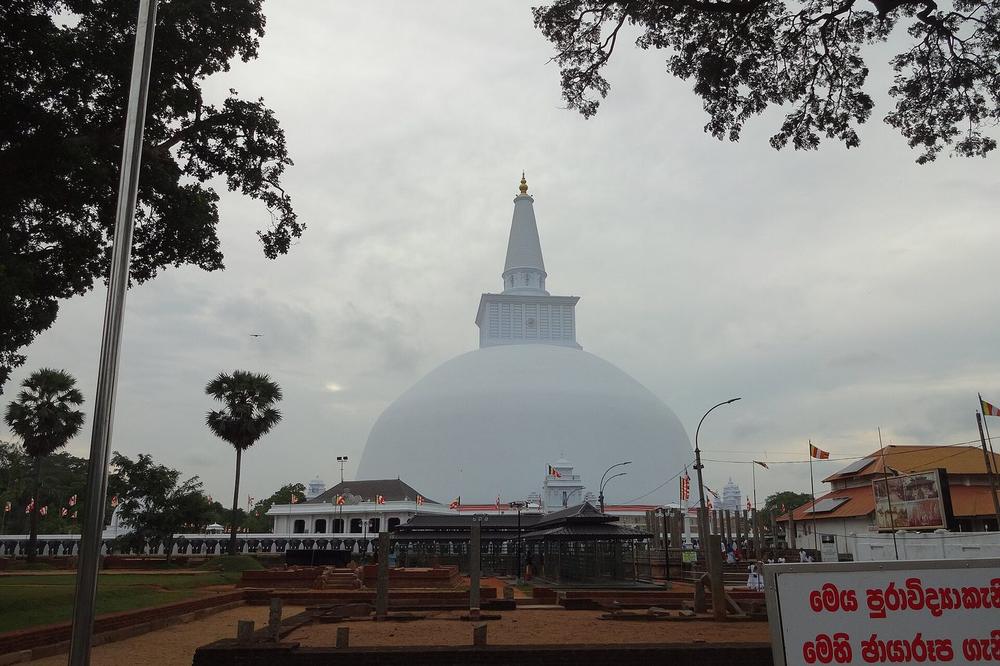
The afternoon is the sacred quarter. The bo tree at Sri Maha Bodhi grew from a cutting brought here in the third century BC and has been tended without a break ever since; the people at the rail are there for reasons that have nothing to do with heritage, and the dress code that goes with that — white, shoulders covered — is not a suggestion. The great brick stupas around it are still being replastered, and the only way to take the size of one in is to walk a full circuit, which takes longer than you expect.
Anuradhapura by bicycle, and Mihintale
The ancient city is spread across enough ground that walking it wastes a day and driving it removes the point, so we do it on bicycles: the monastic refectories with their stone rice troughs, the twin ponds, the moonstones at the Abhayagiri, and the Samadhi Buddha, a seated figure of about the fourth century whose face changes as you move round it. Flat ground, shade in patches, and no traffic worth the name.
Mihintale in the late afternoon, a short drive east. Buddhism arrived in Sri Lanka on this hill and the approach is a granite stairway climbed in long shallow flights, which sounds worse than it is because the treads are broad and the shade is continuous for the first half. Go up for the last hour of light, when the pilgrims come and the heat has gone out of the rock.
South-east to Sigiriya, and the painted caves
A short drive to the paddy country around Sigiriya, where you sleep for three nights and stop packing. Dambulla takes the afternoon: five chambers hollowed out of a rock flank and painted floor line to roof, the brushwork bending with the natural curve overhead instead of arguing with it. Footwear is left at the gate, and by three the paving is hot enough that the socks handed to you at the entrance are equipment rather than courtesy.
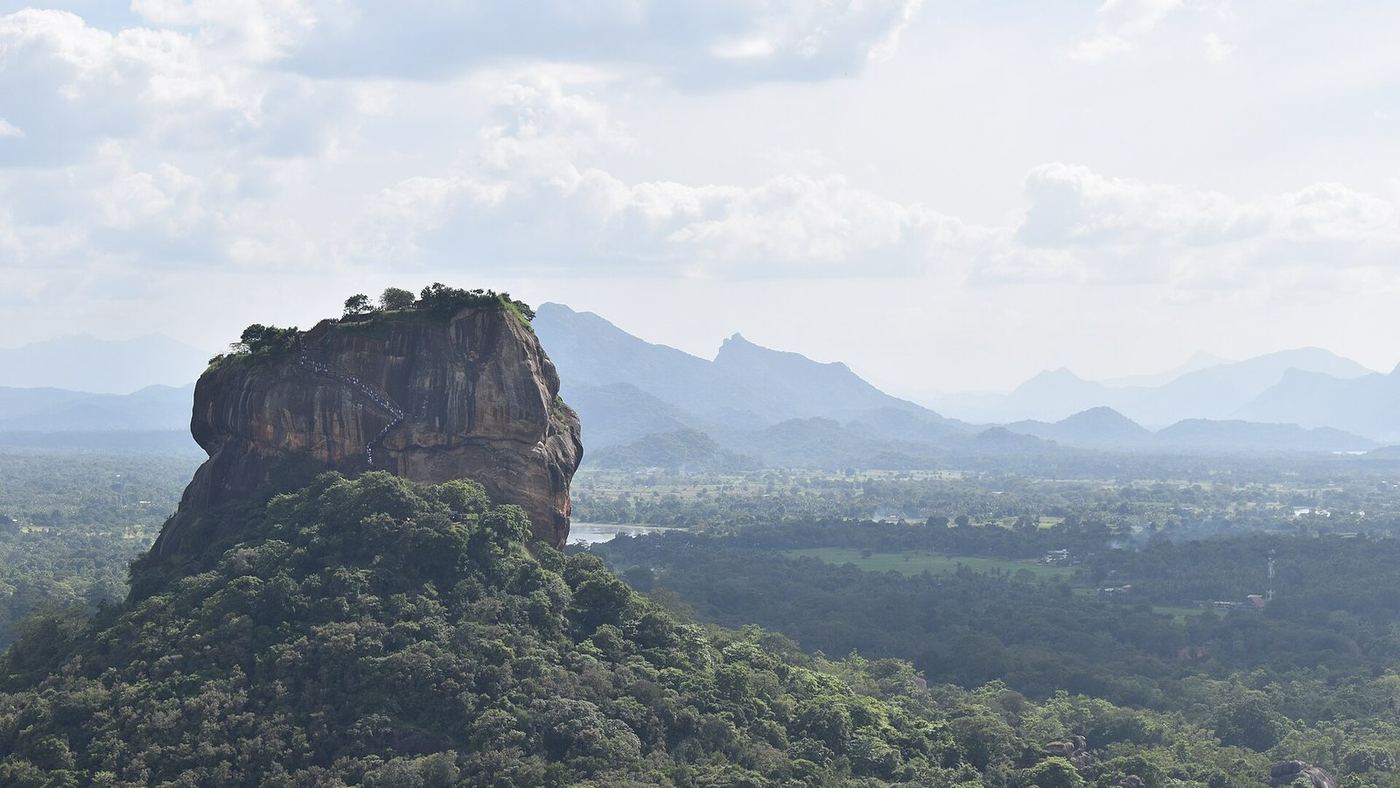
Sigiriya at opening
Gates at seven, water gardens by ten past. From there the route works through the fallen boulders, along a caged walkway pinned to the rock face, past the painted figures sheltering under their overhang, and out between the lion’s paws for the last open metal flights. There is no shade on it, it turns unpleasant after nine, and from about half past eight the descending traffic and the ascending traffic share the same treads.
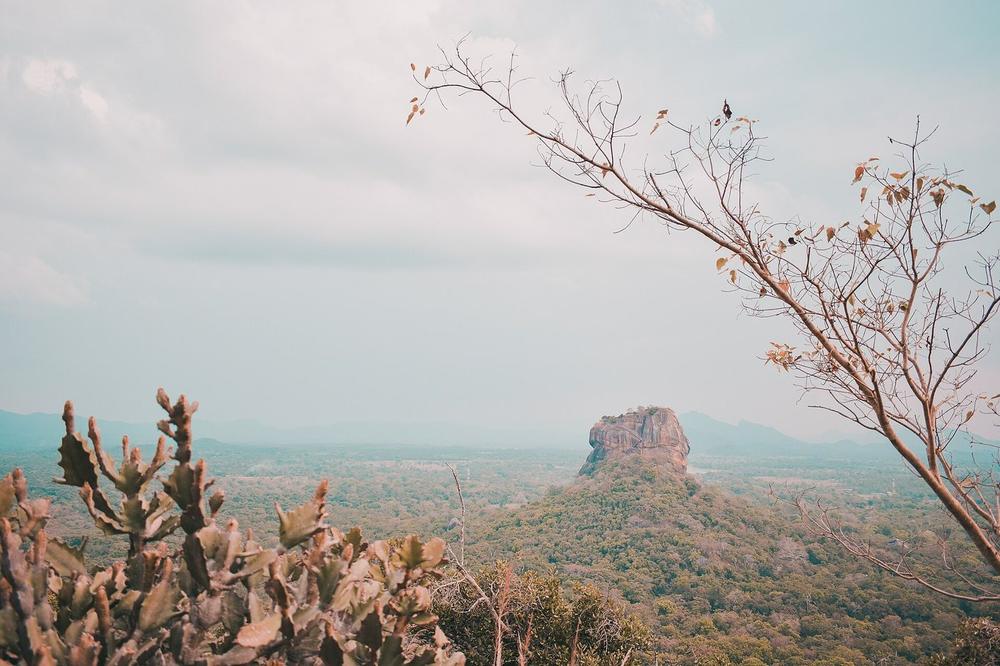
The alternative for anybody who would rather not take those stairs is Pidurangala, the rock standing opposite: a scramble at the top, and the one place from which you can look at Sigiriya rather than out from it. Then a free afternoon, deliberately. This is the middle of nineteen days and a good day to spend beside a pool.
Polonnaruwa, the second capital
The medieval capital, and the third stage of a sequence you have now been following for five days: Anuradhapura abandoned, the court moved south-east, the same hydraulic engineering rebuilt at a smaller scale by a king who wrote that not a drop of rain should reach the sea unused. The site is flat and spread out and, like Anuradhapura, best on two wheels.
What justifies the day is the Gal Vihara: four images worked out of one granite face, the reclining figure among them being the piece of carving on this island that people go back for a second look at. The end of the afternoon is a jeep at whichever of Minneriya or Kaudulla the elephants are using, since they follow the falling water from one tank to the next; the park gets a telephone call from your driver that morning rather than a guess. Herds elsewhere means you are told so and the afternoon stays yours.
South into the hills to Kandy
Through Matale and up into the hills. The stop we make is the Nalanda Gedige, a small stone shrine standing alone above a reservoir, built in a form that is Hindu in its plan and Buddhist in its use and settles the question of how separate those two things ever were here. The spice gardens along this road are shops with a lecture attached and we will tell you that rather than let you find out at the till.
Kandy in the afternoon. Rather than the temple on the first evening, we walk: the lake circuit, and then up into Udawattakele, which is a genuine tract of wet-zone forest directly behind the palace, kept as a royal reserve and now full of monkeys, monitor lizards and a great deal of bird inside a working city.
The tooth relic, and the temples west of the city
The morning puja at the Temple of the Tooth. Drums are already going before the inner doors are opened and the file past them does not linger. What stands in that chamber is the most politically freighted object anywhere in the country and the building around it is a functioning shrine, so white clothes and covered shoulders and knees are the floor rather than the recommendation. Nobody lays eyes on the relic. Seeing it was never what the visit was.
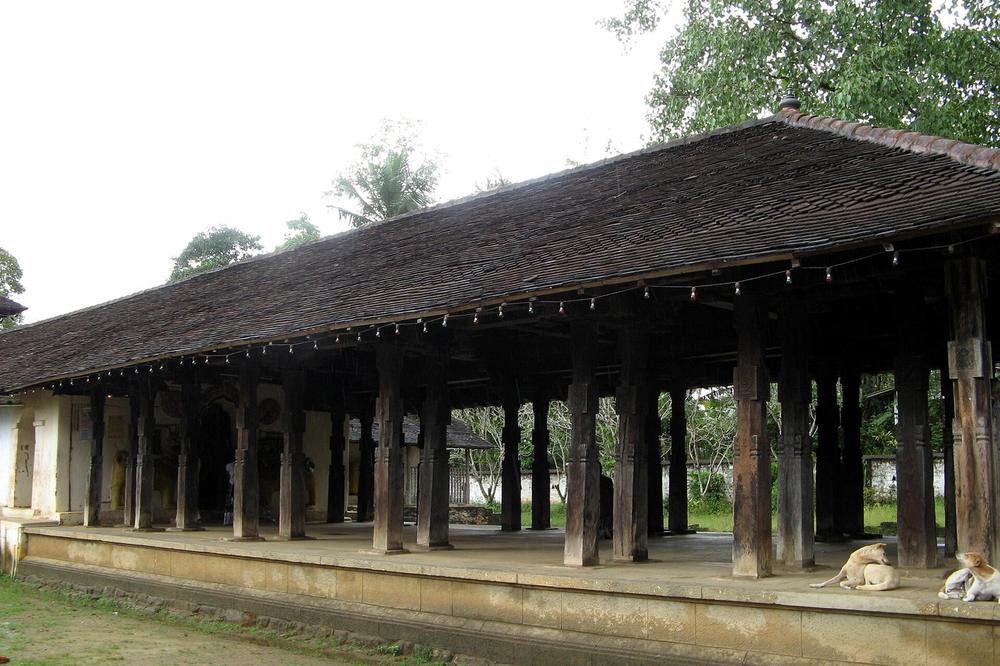
The afternoon is the loop that almost no itinerary includes: Gadaladeniya on its rock, stone-built and South Indian in its detailing; Lankatilaka, which stands on the same outcrop and was a good deal higher before it lost its upper storeys; and Embekke, whose wooden pillars carry the best secular carving in Sri Lanka — wrestlers, dancers, a mother and child, a double-headed eagle. Three fourteenth-century buildings within a few kilometres of each other and, on most afternoons, nobody else there.
Up into the tea
The road climbs through Ramboda and past the waterfalls into the high estates, and the temperature drops most of the way. This is planter country: bungalows built for men sent out by companies in London and Glasgow, laid out with lawns and fireplaces high in the hills because that is what they knew how to build.
The afternoon is a working estate rather than a visitor centre. Why a bush is held at pluckable height for a hundred years, why the leaf count is what it is, what the withering lofts and the rolling machines do, and what the estate wage is — the Tamil workforce here was brought from south India by the British in the nineteenth century, and the fact that you are flying to their ancestral coast in three days is not a coincidence anybody on this route should miss.
The train down to Ella
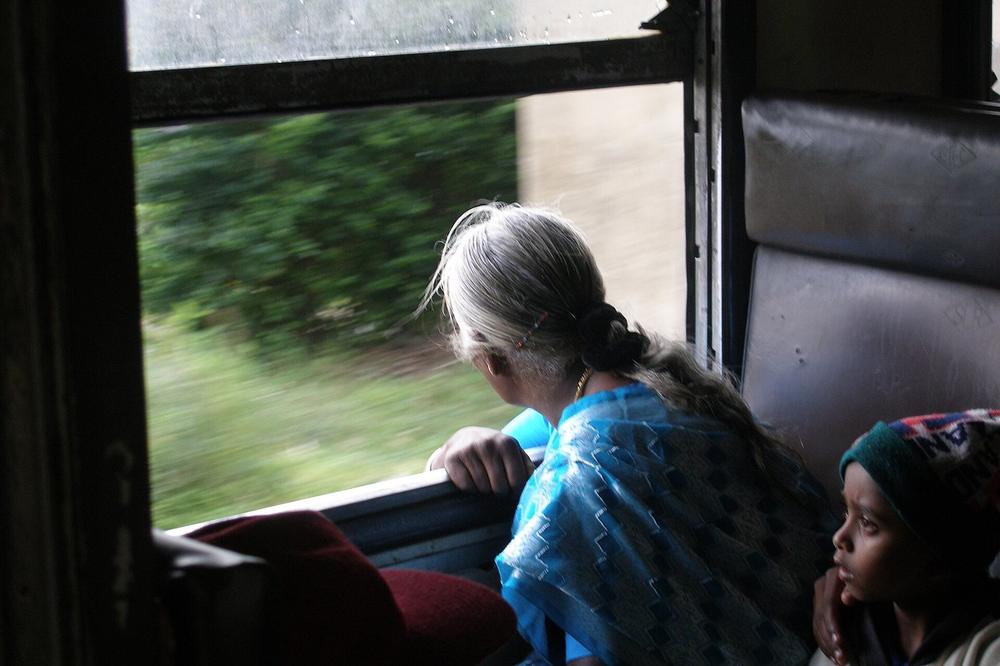
The Kandy to Ella line covers about 120 kilometres and takes six to seven hours end to end, which is the whole product. We take the upper half of it, boarding at Nanu Oya after a slow morning on the estate, which keeps the best of the scenery — the contour running above the drops, tea to the horizon, and in the final stretch the viaduct of nine arches under Ella — and cuts three hours of sitting from a journey that has plenty of sitting in it already.
Reserved seats in Second, not the air-conditioned First, because a sealed window removes the only reason to be on the train; and seats on the right, which is the side the country falls away from going this way. Between December and April they are gone months out. Car and luggage go round by road with the driver, who is on the platform at Ella.
Down to the south coast
Little Adam’s Peak at first light: an easy ridge, under an hour, and not to be confused with the pilgrimage mountain that shares the name. Then the road lets go of the hills by way of Wellawaya, picking up a degree every few minutes until you are at sea level again in dry heat and palmyra.
The afternoon is Bundala, a chain of coastal lagoons and salt pans east of Hambantota, which is a bird reserve rather than a big-game park and is the better choice for it: waders, painted storks, crocodile, and the winter migrants that come down the Indian flyway in exactly the months this journey runs. It is quiet in a way the first block at Yala, an hour further on, is not.
Colombo to Kochi
A slow morning on the coast, then the southern expressway north, which makes the run to the airport manageable; the unreliable section is the last part around Colombo and we build a wide margin into it. Your Sri Lankan driver hands you over at departures.
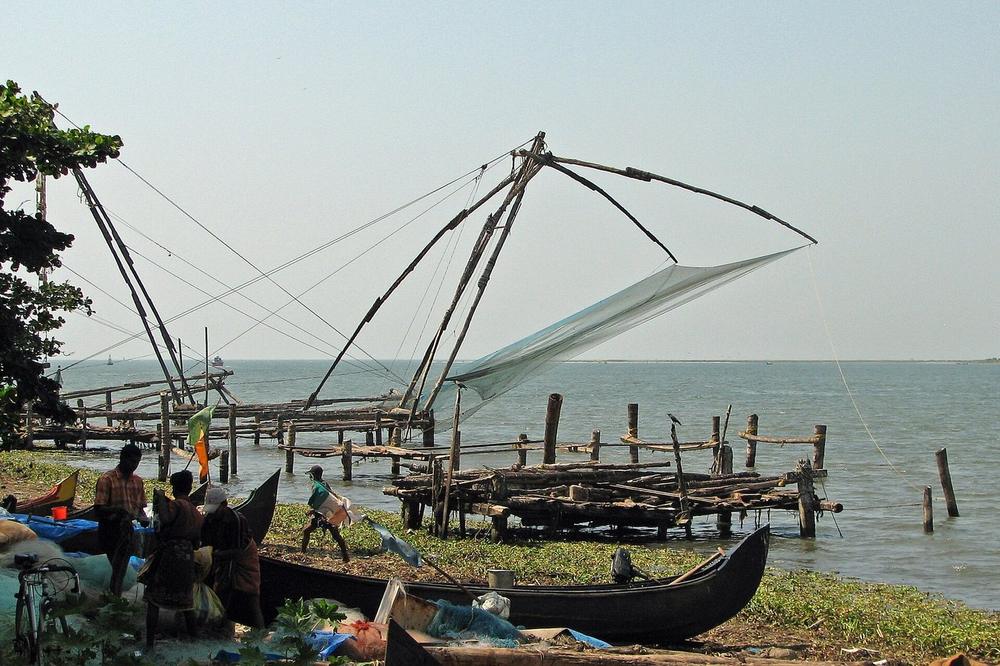
Kochi in the afternoon, and roughly an hour and a quarter from the airport down to Fort Kochi, a peninsula on which traffic ceases to be a consideration. Nothing else is scheduled. What to do with the first evening is the north sea wall, where the cantilevered Chinese nets get hauled by hand as the tide turns and then stand idle until it turns again.
Fort Kochi and Mattancherry on foot
A morning walking the peninsula behind a guide who can hold four centuries in sequence: church built by the Portuguese, graveyard left by the Dutch, Residency put up by the British, a synagogue in a quarter that has not stopped smelling of the pepper stacked around it, warehouses where cardamom and ginger are still sorted by hand on the floor. This port was trading long before Europe arrived and went on trading after, and the buildings are what is left of the paperwork.
The afternoon has an argument in it that you have been walking towards since Anuradhapura. Everything you saw in Sri Lanka — the Buddhism, the stone shrine forms at Nalanda and Gadaladeniya, the estate labour in the hills — arrived across this water or left from it. Your Indian guide is briefed to pick that up rather than start the country again from scratch.
Muziris, the port that disappeared
North of Kochi, along the channels, sits the ground archaeologists now think was Muziris: the port Roman writers named, where pepper went west for gold until a flood in the fourteenth century moved the river and killed it. What survives is a string of small sites within a few kilometres of each other and almost no visitors — the synagogue at Paravur, the Jewish and Syrian Christian quarters at Chendamangalam, a Portuguese-era church, a mosque that claims descent from the first in India.
We do the last stretch by boat rather than by road, because the channels are how the whole thing worked and because the road version of this day is a series of car parks. This is the best day in Kerala for anybody who came to south Asia for its history rather than its water, and it is the one most itineraries skip entirely.
South to Alleppey and aboard
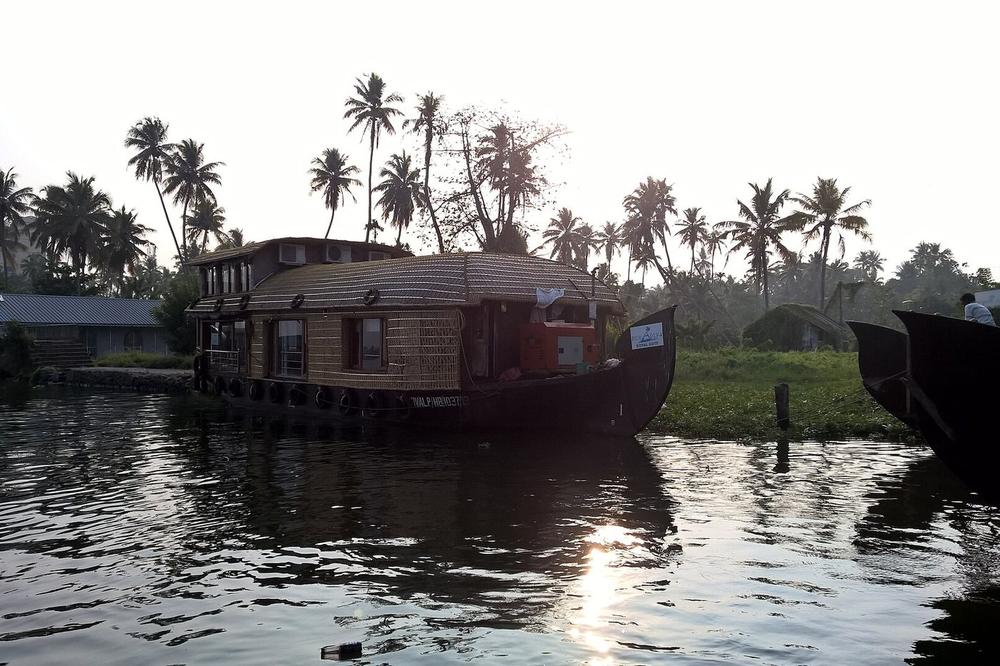
Down the coast road to Alleppey and aboard at about noon. What you are floating on is a system of lakes, cut channels and rice polders sitting under sea level, farmed by the people whose houses line the banks — and the fleet working it is large, and not all of it behaves.
The boats we use carry a sealed waste tank and three crew, and the mooring for the night is a narrow channel rather than the open lake in company with sixty others. Slowness is the design. Lunch is cooked on board, the fish arrives alongside in somebody else’s boat, and the engine is off by about five.
Off the boat at Kumarakom
Ashore after breakfast on the eastern shore of Vembanad, the lake every one of those channels feeds. A single night afloat is the correct dose. The first afternoon carries the entire idea, and by the middle of a second day almost everybody wants to be standing on something that holds still.
Kumarakom is where you stand on it. The bird sanctuary here is small, walkable and best in the two hours after dawn, and it is on the same migratory flyway as the lagoons at Bundala five days ago — the same species, wintering at either end of the same short sea. The rest of the day is the lake, a canoe in the smaller channels where a houseboat cannot go, and an early night.
West to the coast at Marari
A short drive back across the polders to the sea. Mararikulam is a working fishing village with a long open beach behind it, and it is not a resort strip: the boats go out at night, the catch is landed in the morning, and the hotels sit behind a coconut belt rather than on the sand.
The afternoon is nothing. After eleven days in Sri Lanka and five more of Kerala, the last two nights of this journey are deliberately empty, and every time we have tried to put something in them the clients have quietly cancelled it.
Marari, free
Nothing scheduled. There is a shore break here and there is a current, and the flags on the beach are not decorative. For anybody who would rather be doing something, two suggestions: the sand at first light while the night’s catch is sold, which lasts about twenty minutes and finishes before most guests are awake, and a proper ayurvedic consultation followed by treatment, which wants three hours and bears no relation to a spa massage.
This is also the day to do the thing nobody plans for: sit down with your guide and work out what you would change. We ask for it, we write it down, and it is how the next version of this route gets better.
Depart from Kochi
Breakfast, then about an hour and a half north to Cochin airport. Anybody flying out in the evening keeps a room for the day instead of sitting in reception, and Gulf connections want their flight number sent to us a week out so the car leaves to suit the aircraft and not the front desk.
What it costs, and how the number is built
| Party size | Comfortable | Considered |
|---|---|---|
| 2 travellers | USD 8,000 | USD 10,900 |
| 3 – 4 | USD 6,650 | USD 9,050 |
| 5 – 8 | USD 5,900 | USD 8,000 |
Two countries in two different price bands make the total look like a guess unless you can see it assembled, so here it is assembled.
At the middle of our band, land only, for a party of four: Sri Lanka works out at USD 250–360 per person per day and India at USD 190–300. Nineteen days at the Sri Lankan rate would land somewhere around USD 4,750 to USD 6,840; nineteen at the Indian rate, somewhere around USD 3,610 to USD 5,700. Eleven of the eighteen nights here are Sri Lankan, which pulls the from-price into the Sri Lankan half of that spread instead of leaving it midway, and the Colombo to Kochi flight is carried inside the figure rather than added to it.
Transport is the line that swings hardest. In Sri Lanka the daily figure for an air-conditioned sedan and its driver is about USD 50 to 70, and about USD 70 to 90 for a van seating three to six, each covering fuel, tolls, parking and the driver’s own meals and bed. Across the water a sedan and driver comes to roughly USD 45 to 60 a day and an Innova-class SUV roughly USD 65 to 90. A couple shoulders all of that between two people while six divide it, which is what puts the top row 36% above the bottom and matters a great deal more than the hotel grade.
Comfortable is the estate bungalow above Dickoya, the lodge among the paddy at Sigiriya and the heritage house in Fort Kochi, all of them picked for where they stand rather than for a star rating, and in India broadly the USD 60 to 120 a night band. Considered is the handful of properties on either side of the water genuinely worth their rate, which here means the hill country, the Kerala coast and one or two houses in Kochi, and in Indian terms the USD 180 to 400 a night tier and upward. The houseboat is the one line where the two grades diverge in a way you would notice: a cheap boat and an expensive boat photograph almost identically and are not remotely alike after dark, and the difference is the waste tank and the crew.
A tip of about USD 5 to 10 a day for the Sri Lankan driver is the local custom and we leave it out of the price on purpose, because the judgement should be yours. Everything else, supplier by supplier, is broken out on the prices page.
What is and is not included
What the price includes
- Eighteen nights as listed, each property named in your quote
- A private air-conditioned vehicle and driver in Sri Lanka, and a second private car and driver in India, from airport to airport in each country
- A national guide in Sri Lanka and a national guide in Kerala, plus site specialists at Anuradhapura, Polonnaruwa and the Muziris sites
- The Colombo to Kochi flight, booked with a wide connection margin
- Reserved Second Class seats on the Nanu Oya to Ella train, booked as early as the railway allows
- The private houseboat for one night with its crew, fuel and all meals aboard
- Bicycles at Anuradhapura and Polonnaruwa, and the Muziris boat leg
- Two jeep outings with park entry: one at Minneriya or Kaudulla, one at Bundala
- Every entrance fee listed day by day, at the rate current when we invoice
- Meals as listed on each day, and drinking water in both vehicles
What it does not include
- International flights into Colombo and out of Kochi
- The Sri Lankan ETA, which is free for our four markets but still has to be applied for online and approved before you fly
- The Indian e-Tourist visa: USD 25 for arrivals July to March, USD 10 April to June, plus a 3% bank charge, with a higher reciprocal fee for UK passports
- Travel insurance, which we require and do not sell
- Meals not listed above, and all drinks
- Ayurvedic treatments at Marari, which we book and you pay locally
- Camera fees where a Sri Lankan site charges one separately
- Tips for the two drivers and the two guides, customary in both countries and never built into our prices
The journey in pictures
Who this journey is wrong for
- Travellers whose only free weeks fall between June and September. This is the one route on our list that cannot be rescued by moving coasts. A Sri Lanka trip in July goes east to Trincomalee and works; bolt Kerala onto it and you have put the Indian half into the four wettest weeks of its year, because Kerala has one coast and the monsoon reaches it first. We will decline the booking rather than sell it.
- Anyone who cannot manage the Sigiriya stairway, the granite steps at Mihintale or a day on a bicycle. Three of the first six days involve one of the three. Pidurangala is an alternative to Sigiriya and a jeep is an alternative to the bicycle, but Mihintale has no version from the car park and the ancient cities are the reason the Sri Lankan half is eleven nights rather than seven.
- Anyone who wants Munnar and the Kerala tea country. We leave it out on purpose. You will have spent two nights in the Sri Lankan hill country and half a day on the plantations above Dickoya by the time you land at Kochi, and a third helping of tea would cost two of the four nights that make the Indian half worth having. If Munnar is what you came for, the ten-day Kerala journey gives it two nights and does this route’s job differently.
- Anyone expecting a beach fortnight with sightseeing attached. There is one night at Tangalle and two at Marari, and Marari is a fishing village rather than a resort strip. Nineteen days on this route is fifteen days of moving and three of stopping. If the ratio should run the other way, say so at the enquiry and we will cut a stop rather than pretend the schedule is restful.
- Anyone whose reason for coming is big game. This route deliberately trades Yala for Bundala and puts a bird reserve at both ends of it. Yala’s first block holds the leopard density everyone quotes and, in season, more jeeps than any leopard tolerates; Kerala’s reserves are inland and are not on this line at all. If cats are the point, the trip is a different one and we will say so before you pay a deposit.
How this compares
| Journey | Days | Countries | From |
|---|---|---|---|
| Sri Lanka and south India | 19 | Sri Lanka, India | USD 5,900 |
| Sri Lanka | 11 | Sri Lanka | USD 3,100 |
| Kerala and south India | 10 | India | USD 2,700 |
| Rajasthan and the Golden Triangle | 12 | India | USD 3,200 |
Bought as two holidays, these are twenty-one days and two long-haul return fares. Bought as one, they are nineteen days and a single fare, and the country you reach second is where the first one’s trade routes were pointing all along — which is a better argument for putting them together than a map is.
The pairing people ask about more often is Sri Lanka with Rajasthan, and it is the weaker one. North India and Sri Lanka do share a season, but the flight is long, the two halves have nothing to say to each other, and the version of it that fits in nineteen days short-changes both. If forts and desert are what you want, Rajasthan deserves its own twelve days.
For each country outside a fixed route, the Sri Lanka page covers the two monsoons as a decision rather than as an itinerary constraint, and the India page sets out how differently the north and the south run. If you are still weighing how long each country needs, how many days does that arithmetic honestly.
Tell us your month
Send the dates, the number of travellers, and whether the ruins or the water matter more. A first draft comes back within two working days, with the hotels named.
Questions travellers ask most
Why will you not run this in July, when you will run a Sri Lanka trip then?
Because the fix for one country breaks the other. Sri Lanka has two monsoons on opposite schedules, so a July departure simply moves from the southwest coast to Trincomalee and the east, which is dry from June to August, and the triangle and the hill railway run unchanged.
Kerala has no equivalent move. The Indian monsoon makes landfall there before anywhere else in the country and stays broadly from June to September, and the only other coast is on the far side of the peninsula in a different state. So a July version of this journey would be a good Sri Lankan half stapled to an Indian half in its worst weeks. January to March is the window; December works.
Why is there no Munnar in the Kerala half?
Because you will already have had tea. Nights nine and ten are in the Sri Lankan hill country, day nine is spent on a working estate above Dickoya, and day ten is a train through the plantations. Adding Munnar means two more nights of the same crop at a similar altitude, and on an eighteen-night budget those two nights have to come from Kochi, the backwaters or the coast.
The swap we make instead is the Muziris day on day 14, which has no equivalent anywhere in Sri Lanka and is the single most interesting thing in the Indian half for anyone who has just spent eleven days looking at what moved across that water. If you would rather have Munnar than Muziris, we will build it; we simply would not recommend it in this order.
What paperwork do two countries need, and in what order?
Sri Lanka first, and it costs nothing. The ETA fee was dropped on 25 May 2026 for 40 nationalities, ours among them, and what it buys is 30 days with double entry. Free is not the same as automatic: the form still goes in online and has to come back approved before you board. The official link travels with your documents, because the sites that levy a service charge for it sit above the government page in search results.
India second, and this one is paid for. A 30-day e-Tourist visa is USD 25 on a July-to-March arrival and USD 10 on one falling between April and June; add 3% for the bank, and rather more again if the passport is British. The window opens 120 days before travel and shuts four days before arrival; most approvals return inside about 72 hours. Every country we sell is set out, entry rule by entry rule, on the visas and entry page.
Why only half the Kandy to Ella train?
The full run is about 120 kilometres and six to seven hours, and the first half of it is the ordinary half: the descent out of the Kandy valley before the tea starts. The upper section from Nanu Oya carries the contour running, the plantations and the Nine Arch Bridge, and it costs three fewer hours of sitting on a journey that already asks you to sit a good deal.
Those three hours go instead into the estate morning on day nine, which is the better spend. The booking is Reserved Second rather than air-conditioned First, since First seals the windows and removes the point of being aboard, and the seats are on the right, which is the side with the drop on it in this direction. Between December and April they have to be held months in advance. Anyone in the party who would rather not sit that long travels with the driver and joins you at Ella.
Read next
Tell us about the journey you have in mind
Dates, party size and the places you care about are enough to start. You get a draft route and an indicative price, not a brochure.