Three countries along one mountain wall, twenty nights
Delhi and the Taj, then the burning ghats at Varanasi, then a visual approach into Paro, two Bhutanese valleys and a third almost nobody drives to, and finally the Kathmandu valley and one night walked up into the Annapurna foothills.
At a glance
- Duration
- 21 days, 20 nights
- Party
- Private, 2 to 8
- Starts
- Delhi
- Ends
- Kathmandu
- Difficulty
- Moderate, two hard walking days
- From
- USD 8,200
Three countries share the southern face of the Himalaya and none of them feels like the other two. India is loud, hot at the bottom and enormous. Bhutan is a managed country where the government charges you by the night for the privilege and spends the money in public. Nepal sits between them, poorer than Bhutan, quieter than India, and the only one of the three where an ordinary traveller can put boots on a hill path and be somewhere in four hours.
Twenty-one days is what it takes to hold all three separately in your head. Two weeks would give you north India and a fortnight-shaped sample of one mountain kingdom; three weeks gives you six Indian nights, seven Bhutanese and seven Nepalese, which is enough for each country to establish its own weather, its own food and its own argument.
This is a moving journey with fourteen changes of bed and six flights inside it, two of which cross a border. If what you want is one country done slowly, the nine-day Bhutan journey and the ten-day Nepal journey exist for exactly that reason, and we would rather point at them now than have you tired by day twelve.
Day by day
Delhi’s air. Roughly October to January is the bad season and the mechanism is well understood: crop residue burnt in the states to the north, a winter inversion that will not let any of it rise, and a whole city’s traffic and construction underneath. Delhi sat among the world’s ten most polluted cities in October 2025 with an index above 200, against a 2024 annual average of about 178, which is already inside the unhealthy band. This route answers that in two ways: sightseeing between seven and eleven, and three Delhi nights in total, one of them nothing more than a sleep beside the airport.
The Paro flight. Two airlines land there, Drukair with five aircraft and Bhutan Airlines with two. The certification for that approach is held by fewer than two dozen pilots anywhere in the world. It is flown by hand, in daylight, in good visibility, with no ILS and no radar — one VOR beacon and a set of ridges that reach 18,000 ft above an airport at 7,364 ft with a 7,431 ft runway. Cloud delays and diverts flights and there is no alternate inside the country. Day 11 at Phobjikha is the night this itinerary is designed to surrender if the inbound flight loses a day; Taktsang is not.
The Nepali guide rule. A licensed guide has been compulsory for trekking since 1 September 2023 and enforcement tightened through 2026 with QR-code scanning at checkpoints and manifest checks. It applies to our single walking day above Nayapul exactly as it applies to a three-week circuit. The ratio the law permits is one licensed guide to seven trekkers, so a full party of eight walks with two of them, and both are inside the price.
Arrive Delhi
Met at Indira Gandhi International and driven in. Almost every long-haul arrival from Europe, North America and Australia lands in the small hours, so the room is held from the previous morning rather than from a midday check-in. Nobody should begin a three-week journey in a lobby.
Nothing is scheduled. If you land in daylight and still have legs, Lodhi Garden is a short drive away and holds fifteenth-century tombs standing among people doing yoga in front of them, which is a gentler first hour of India than the old city would be.
Delhi, out early
Away by seven. The old city first: Jama Masjid from the eastern steps, then Chandni Chowk on foot while it is still a wholesale market rather than a spectacle, and the spice lanes at Khari Baoli, where everyone who works there will watch you cough and find it reasonable.
Humayun’s tomb after that. The Taj is its architectural grandchild, and a fair number of people who see the two inside one week end up preferring the older building: garden first, geometry second, and nobody much there at nine in the morning. Sightseeing stops at noon on purpose, and the afternoon goes indoors with the windows shut.
Delhi to Agra
The Yamuna Expressway covers the 230 km in three to three and a half hours, with another thirty or forty minutes to clear central Delhi at the start. It is a good road and a boring one, which is the correct combination for a transfer.
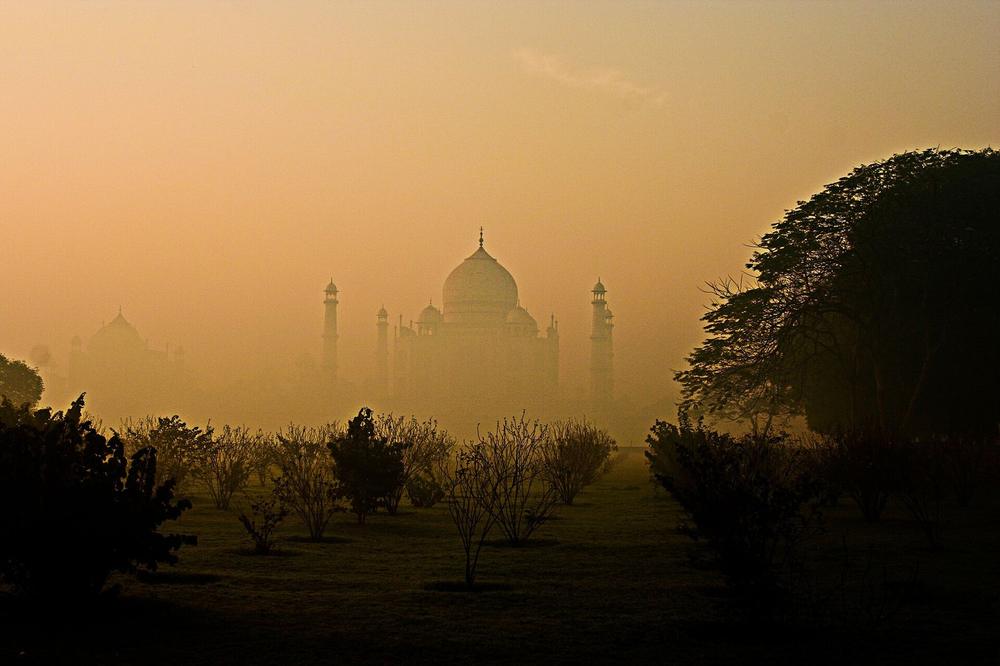
Agra Fort takes the afternoon and it is the monument that most twenty-one-day itineraries reduce to an hour. It is a red sandstone city inside walls, it holds the marble rooms in which Shah Jahan spent his last years under arrest by his own son, and from the east wall you look across the river bend at the building he had made for his wife. See it in that order, from that wall, and tomorrow morning is a different experience.
The Taj at opening, then east to Varanasi
Standing at the east gate before the ticket window opens. A foreign visitor pays INR 1,300 and the price carries shoe covers, a bottle of water and the electric shuttle that runs the last stretch, because fuel vehicles are held back from the building. A second INR 200 buys the mausoleum chamber, and it is the INR 200 to spend: the pierced marble screen and the inlay on the cenotaphs are what the reputation actually rests on, and neither is visible from the plinth outside.
Worth knowing before you are standing in front of it. The marble has been going yellow and green for years under pollution, dust and biological growth carried off the Yamuna; the archaeological body responsible has been operating with something like 29% of its conservation posts vacant; and the courts have been leaning on the government over all of it for far longer than you have been planning this trip. Nothing is closed. Nothing is white either.
Then the longest transfer of the Indian leg: back up the expressway to Delhi through the middle of the day and the evening flight east. Varanasi at night is a slow drive from the airport into a city that does not switch off, and dinner is late.
Varanasi
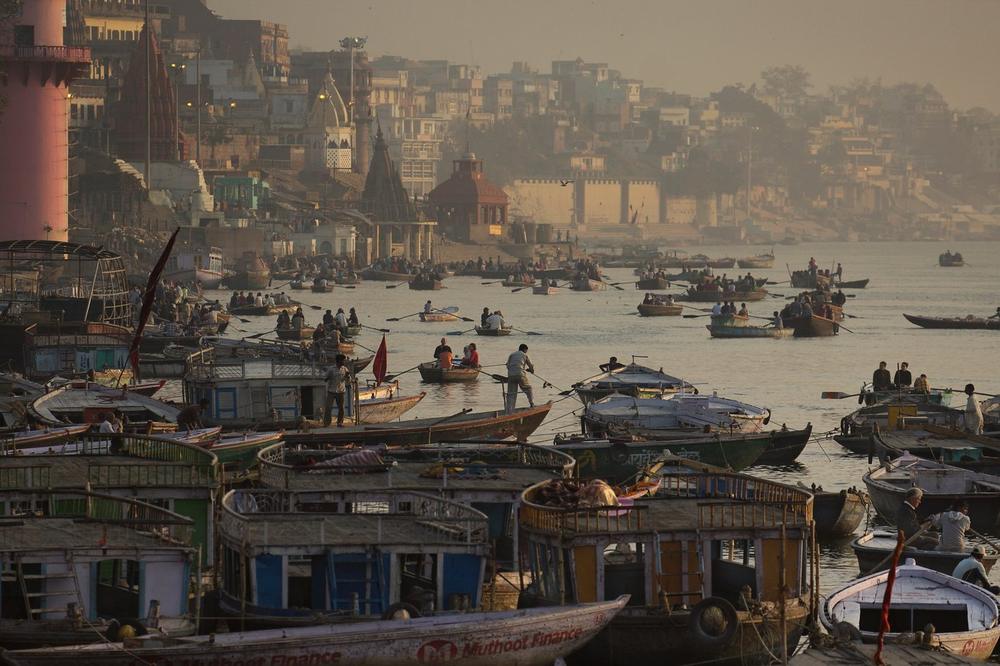
On the water before first light. A rowed boat rather than a motor one, from Assi ghat north with the current, past bathers, wrestlers, laundry and two cremation grounds that work without pause and without an audience gallery. Your guide will tell you where the camera goes down and stays down, and we expect you to do it. This is not a site; it is the place several hundred million people intend to die.
Breakfast, then the lanes behind the ghats on foot, which are too narrow for a car and barely wide enough for the cow already in them. The afternoon is Sarnath, ten kilometres out, where the Buddha gave his first teaching after enlightenment and where the museum holds the lion capital that ended up on every Indian banknote. After Delhi and Agra, which are Mughal and imperial, Sarnath is the first Buddhist ground of the journey, and everything from day 7 onward is built on it.
Varanasi to Delhi, and a night by the airport
The other river hour is the evening one, but you have already had the better end of the day, so this morning is the ghats on foot at your own speed and a late breakfast. The flight back to Delhi is around the middle of the day.
The last Indian night is on the airport side of Delhi and it is a deliberately dull one. The Paro service goes early, the check-in is slow because the passenger list is checked against a visa clearance issued in Thimphu, and nobody should be crossing Delhi at five in the morning at the end of a week. Your Indian guide says goodbye here.
Delhi to Paro
The descent is the thing everyone remembers and there is no point being coy about it. On a clear morning the aircraft runs east along the wall of the Himalaya with the big peaks out of the left-hand windows, then turns into the Paro valley and comes down between ridges with the fields below the wingtip. Ask for a left-hand seat and be at the airport early enough to get one.
Your Bhutanese guide and driver meet you outside, and they stay with you until day 14. The afternoon is light on purpose: the National Museum in the old watch tower above the dzong, which is the best hour anywhere in the country for making sense of what you are about to look at for a week, and then an early night. Paro stands high, the flight has already been a long morning, and almost everybody feels the altitude on the first evening.
Paro to Thimphu
An hour east along the river and up the next valley. Thimphu has no traffic lights; the main junction is worked by a policeman in a painted box, and the arrangement has now outlived more than one attempt to install a signal.
The afternoon is the working city rather than the monuments. Changlimithang, where archery is played on a full-length range with a target you can barely see from the shooting line and a great deal of shouting between shots; the paper workshop, where daphne bark becomes sheets by hand; and the Folk Heritage Museum, which is a three-storey farmhouse arranged as it was lived in, and is more useful than any temple for understanding what you will see out of the car window for the next five days.
Thimphu, and the climb to Phajoding
Up the hill behind the city on foot. Phajoding is a scattered monastic settlement on the slope above Thimphu, reached by a forest path of about two hours of steady climbing, and it is the reason this day exists: it is a real ascent at altitude, four days before Taktsang, and how you feel at the top of it tells your guide more than any conversation will.
Down for a late lunch, then the National Institute of Traditional Medicine, where the pharmacy still compounds from high-altitude plants collected in season and the dispensary is a functioning part of the national health service rather than a display for visitors. If it is a weekend, the Thimphu market takes the afternoon instead and it is the better swap.
Thimphu to Punakha over the Dochula
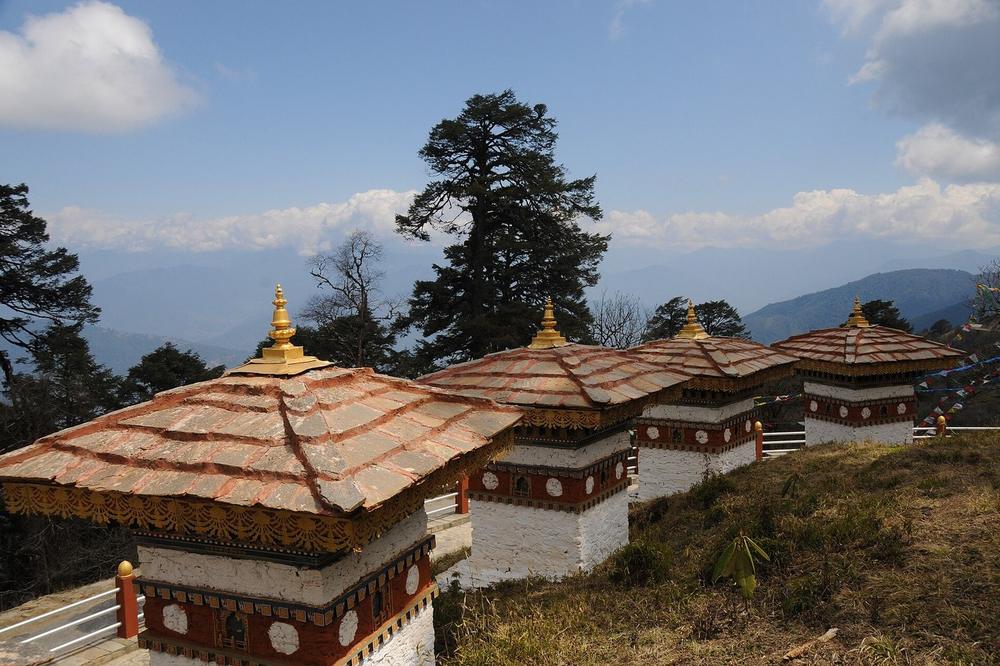
East and up to the pass, where a field of chortens stands beside the road and, on a clear morning between October and February, the eastern Himalaya lines up along the northern horizon. On a cloudy morning you get the chortens, the flags and a cup of tea. We stay for as long as the sky is worth staying for and no longer.
Then a long drop east into ground warm enough to grow rice and bananas, which after two nights in Thimphu reads as a different country. Punakha Dzong stands on the spit where the Pho Chhu and the Mo Chhu meet and is reached across a covered wooden bridge. Go at five, when the light is flat on the whitewash and the monks are moving between courtyards.
Punakha to Phobjikha over the Pele La
The morning is the valley floor: the long suspension bridge over the Pho Chhu, and then Chimi Lhakhang across the fields, where your guide takes the Drukpa Kunley story and the painted village walls head-on and without a flicker of embarrassment, there being none to have.
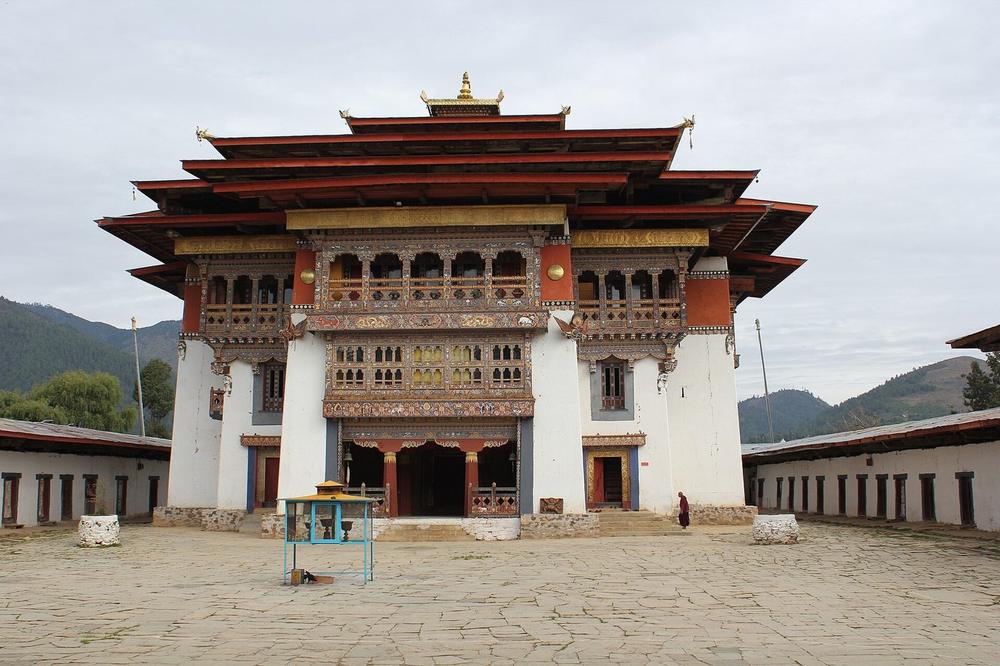
After lunch the road climbs east again over the Pele La and drops into Phobjikha, and this is the part of Bhutan that almost no nine-day itinerary reaches. It is a broad glacial bowl with no terracing in it, a marsh along the bottom, the Gangtey monastery on a spur at one end and dwarf bamboo on the slopes. Black-necked cranes winter here and the valley is managed around them. It is colder than anywhere else you will sleep in Bhutan and the heating is a stove.
Phobjikha, then west to Paro
The Gangtey nature trail first thing: an hour and a half downhill from the monastery spur, through pine and out along the edge of the marsh, and it is the gentlest walk of the three weeks. Take it slowly. The rest of the day is in a vehicle.
Then the long drive back west, over the Pele La and the Dochula again and on past Thimphu to Paro: five to six hours with stops, on a road that is good, narrow, and under widening in places. This is the price of Phobjikha and we think it is worth paying. If your inbound flight to Paro lost a day to cloud, this is the day the itinerary gives up, and you drive straight from Punakha instead.
Taktsang, the Tiger's Nest
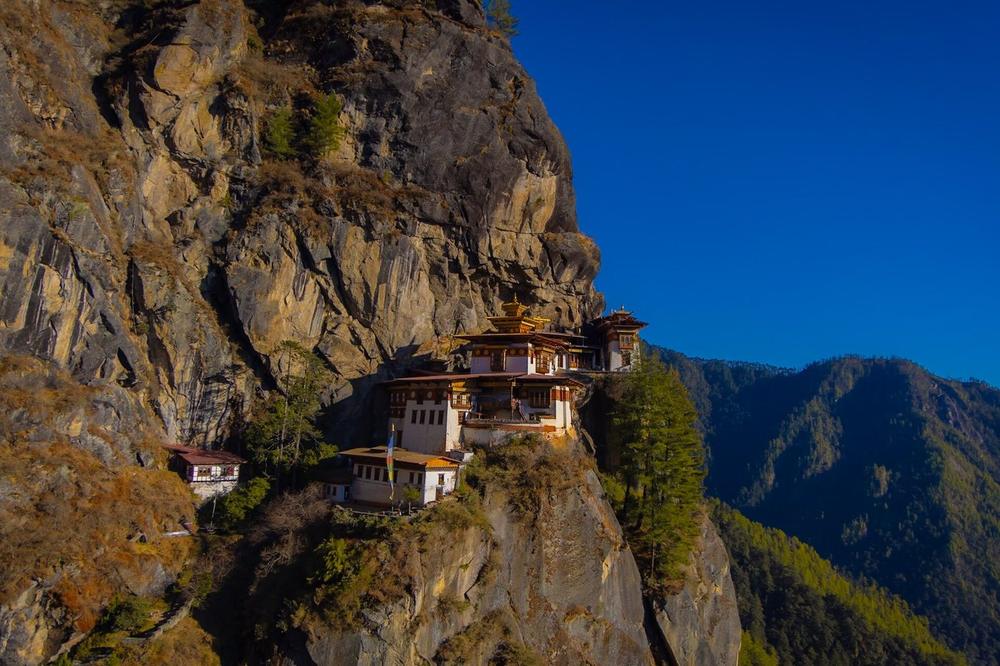
Walking by half past seven. The path goes up through pine to a cafeteria at about the midpoint, on to a viewpoint set directly opposite the monastery across the gorge, then down a long stone stairway into the ravine and back up the far wall to the door. Reckon on two to three hours to reach it and a bit less to return.
Nothing about it is technical and nothing needs a scramble. It is an ascent at altitude and a long one, which is why it falls on day 13: a week of Bhutanese air and the Phajoding climb sit behind you by then. Ponies work part of the way up and none of the way down, and the descent is the half that punishes knees, so the pony gets discussed the evening before rather than at the trailhead.
Everything you are carrying stays at the monastery door — bag, camera, phone, all of it. What is inside goes unphotographed and then gets described at length afterwards by people who had not expected to describe anything, and the two facts are related.
Paro to Kathmandu
Out in the daylight window, as everything out of Paro is. On a clear morning the flight west runs along the range and the cabin crew name the peaks; on a cloudy one it runs above cloud and you land in the valley without having seen anything at all. Both happen.
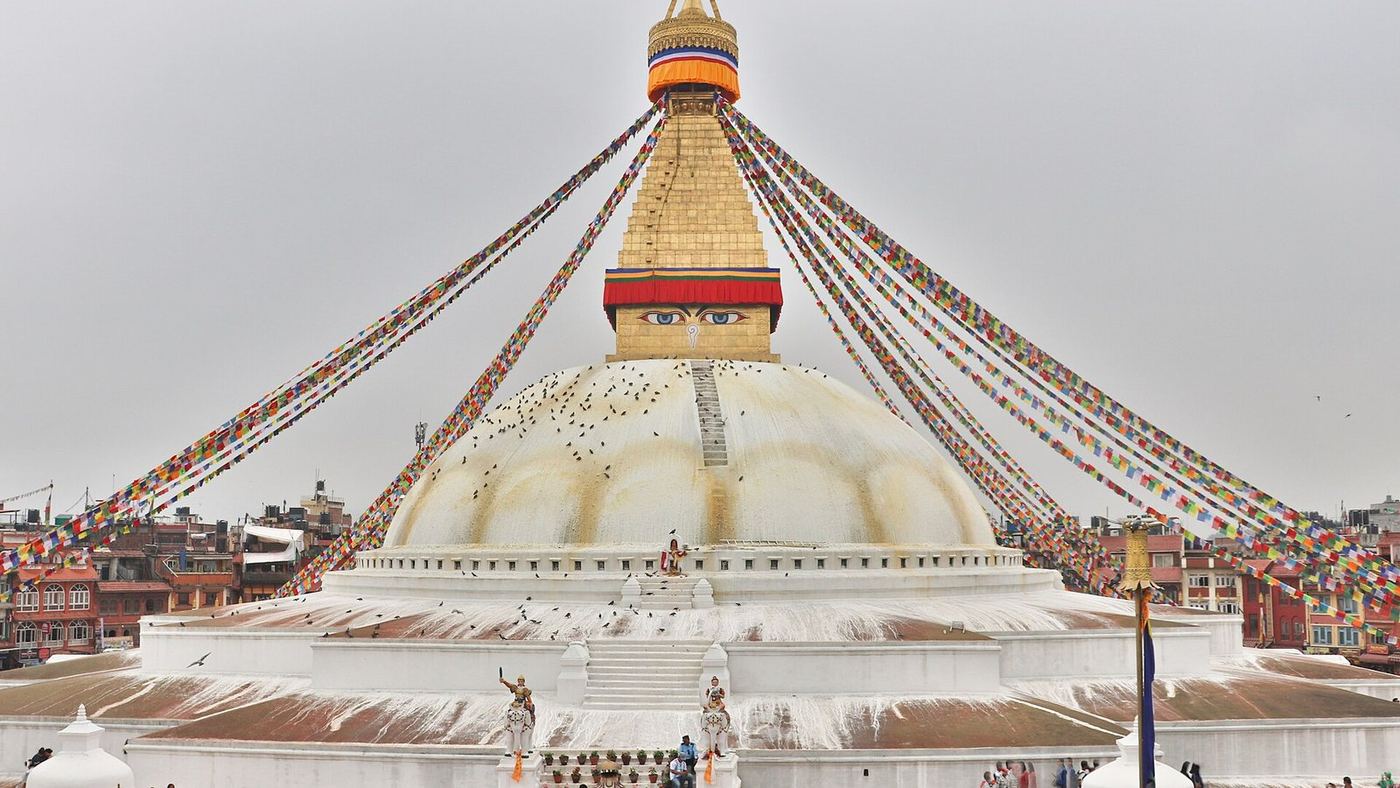
Nothing is scheduled on arrival, and that is the buffer on this side of the journey rather than a wasted afternoon. Your Nepali guide meets you at Tribhuvan. If the day holds together, the thing worth doing at dusk is Boudhanath, where the circuit around the stupa fills after work with people walking it for their own reasons and not for yours.
The valley: Patan and Bhaktapur
Two old capitals in one day, both within half an hour of the third. Patan in the morning for the courtyards and the metalwork: lost-wax casting and repoussé are still worked in the lanes behind the durbar square, and the museum inside the old palace is laid out for somebody walking through it rather than for a cataloguer, which in South Asia is rarer than it ought to be.
Bhaktapur after lunch. What stands here is not a square but an entire medieval town with cars kept out of most of it, a potters’ yard that is somebody’s workplace rather than a demonstration, and reconstruction on view at every stage between finished and a numbered stack of timber under plastic. Coming to this straight out of Bhutan is the point of the ordering. The same Vajrayana Buddhism, the same iconography, practised in a valley of three million people instead of a kingdom of villages, and sharing its streets with Hinduism rather than holding them alone.
Kathmandu to Pokhara
A short domestic flight west. Driving it means the Prithvi Highway: about 200 km, six to eight hours when everything behaves, eight to nine when the monsoon or the traffic does not, and a narrow twisting stretch above the Trishuli that nobody hurries. That is the fallback, and if cloud closes the runway we set off by road early rather than spend a morning at a departure gate.
Pokhara is a lake with the Annapurnas standing behind it and very little else to its name, which after two weeks of monuments is exactly what is wanted. The afternoon is a rowed boat on Phewa, and the evening is the briefing for tomorrow: what you carry, what the porter carries, and what the weather is doing on the hill.
Up to Ghandruk
An hour and a half by road to the roadhead beyond Nayapul, then up on foot with a licensed trekking guide and a porter for the overnight bag. The path is stone steps and village land most of the way, climbing steadily for four to five hours with a long lunch in the middle of it. It is the hardest sustained thing on this journey and it is also completely ordinary: schoolchildren, mule trains and cement all use the same steps.
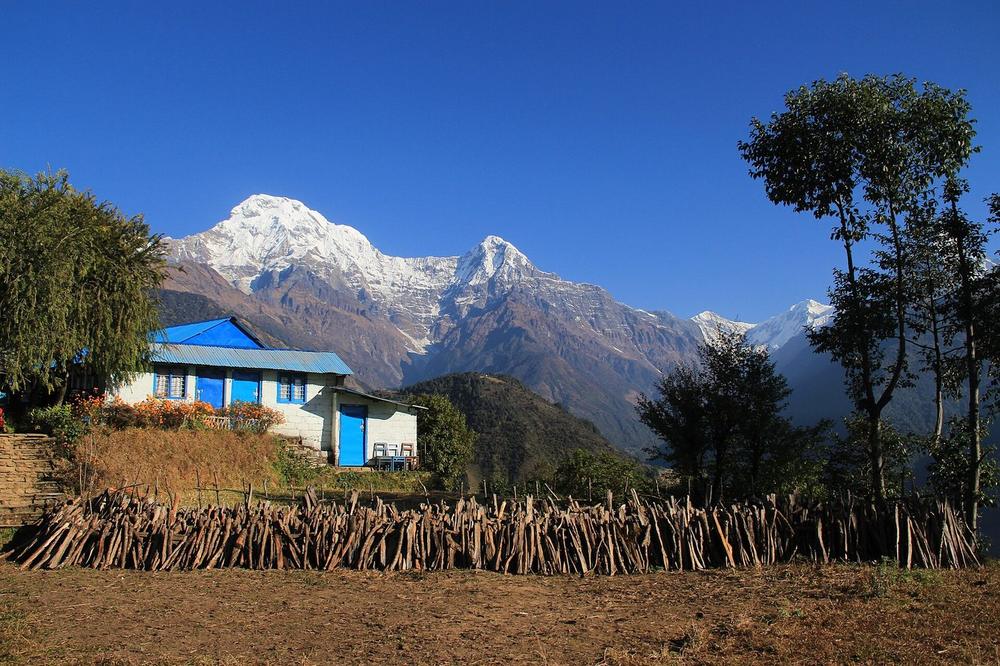
Ghandruk is a Gurung village of slate roofs on a shoulder facing north, and what it has that no viewpoint reached by road has is the fact that you walked there. Annapurna South and Machhapuchhre stand at the head of the valley. The rooms are simple, the dal bhat is better than the description, and the hot water is charged for and not guaranteed.
Down to Pokhara
Out early while the range is still clear, then back down the way you came. Three hours of stone steps taken downwards costs the knees more than the ascent cost the lungs, and it catches almost everybody out. Poles help, and there is a spare pair in the vehicle for anyone who travelled without.
Back at the lake in the early afternoon. The rest of the day is nothing at all, and after eighteen days that is not a gap in the itinerary but the reason the itinerary works.
Pokhara, free
Nothing scheduled. The two things we push are the World Peace Pagoda on the ridge across the lake, reached by boat and then forty minutes on foot through forest, and the International Mountain Museum, which is a serious institution about a serious subject and holds the Nepali side of a mountaineering story usually told from the other end.
The alternative is a chair by the water and a book, and after Taktsang and Ghandruk in six days, most parties take it.
Pokhara to Kathmandu
The morning flight back east, then a free afternoon in the city. This is the hour in which the object somebody looked at on day 15 and walked away from finally gets bought. Your guide comes along for it: the line between a workshop and a showroom on a commission arrangement is invisible from the street, and drawing it is the last useful thing anybody does for you on this journey.
The final night goes to the eastern side of Kathmandu rather than to Thamel. Departures out of Tribhuvan leave early, crossing the city at that hour is the worst driving of the entire three weeks, and the security queue is a real bottleneck that wants three hours in front of it.
Depart Kathmandu
Breakfast and the transfer. A late flight buys a day room instead of an afternoon in the lobby, and where the onward routing runs through the Gulf we want the flight number a week in advance so that the car is timed to the departure rather than to the hotel’s checkout hour.
What it costs, and how the number is built
Every night spent inside Bhutan carries a Sustainable Development Fee of USD 100 per adult. Seven of this route’s twenty nights are Bhutanese, so the sum is 7 × USD 100 = USD 700 per adult, and it is already sitting in all six cells of the table below. No hotel, no airport desk and no closing invoice will come back to you for it.
That USD 100 is a halved rate. The underlying figure is USD 200, and the halving is confirmed to hold until 31 August 2027; what follows that date has not been published. Departures beyond it get the fee quoted on a line of its own and checked again before the balance is due. If it doubles, this journey gains USD 700 a head overnight, and that is not something anybody should discover after paying a deposit.
The fee scales down for children: none below 6, USD 50 a night between 6 and 11, the full USD 100 from 12 upward. Send the ages and the family gets priced properly instead of counted as adults.
| Party size | Comfortable | Considered |
|---|---|---|
| 2 travellers | USD 11,150 | USD 15,150 |
| 3 – 4 | USD 9,250 | USD 12,600 |
| 5 – 8 | USD 8,200 | USD 11,150 |
Three countries at three different price levels make this number look arbitrary unless you see it built, so here it is built.
Taken land only, at the mid-range of our band and for a party of four, a day costs USD 480–650 a person in Bhutan and USD 190–300 a person in both India and Nepal. Twenty-one days at the Indian or Nepali rate would come to somewhere around USD 3,990 to USD 6,300 of land cost; the same twenty-one days at the Bhutanese rate would come to somewhere around USD 10,080 to USD 13,650. Seven of the twenty nights here are Bhutanese and thirteen are not, which puts the from-price between those two spreads and closer to the cheaper one — while Bhutan still accounts for a little over half the land cost out of roughly a third of the nights.
Inside that Bhutanese day rate, USD 100 is the government fee and everything else is a licensed guide, a driver, a car, three meals and a room in a country that does not have many rooms. Subtract the USD 700 from the lowest cell above and USD 7,500 is left to cover twenty nights, three countries and six flights, which is not an outlandish figure anywhere in the Himalaya.
Party size shifts this number more than anything else does. A couple carries a whole car, a whole driver and three whole national guides between two people, and that alone puts the top row 36% above the bottom. On the Indian leg an Innova-class SUV with its driver is roughly USD 65 to 90 a day and a sedan roughly USD 45 to 60, each figure covering fuel, tolls, parking and the driver’s own allowance. None of those lines shrinks because there are two of you in the car instead of six.
Comfortable is the mid-range band, which in India is broadly USD 60 to 120 a night and buys a good deal more character than the price suggests, and in Bhutan and Nepal is the better valley lodges and family-run hotels. Considered is the Oberoi and Taj tier in India at USD 180 to 400 a night and upward, and in Bhutan the small number of internationally-run lodges standing in the Paro, Thimphu and Punakha valleys, whose nightly rates sit near the top of anything Asia charges. Ghandruk is identical in both columns. The village has one standard of room and no second tier to sell you, and a page that implied otherwise would have told you its first lie by the fourth section.
Line by line, before anybody’s margin, the cost of a day on the ground in each of these three countries is set out on the prices page.
What is and is not included
What the price includes
- Twenty nights as listed, each property named in your quote, including the lodge at Ghandruk
- The Bhutanese Sustainable Development Fee, USD 100 per adult per night for 7 nights, USD 700 per adult, paid on your behalf
- The Bhutanese visa, applied for and issued through our licensed Bhutanese partner before you travel
- A national guide in India, in Bhutan and in Nepal, each with you for their own country, plus a licensed trekking guide and a porter on days 17 and 18
- A private vehicle and driver throughout, with fuel, tolls, parking and the driver’s allowance
- Six flights: Delhi–Varanasi, Varanasi–Delhi, Delhi–Paro, Paro–Kathmandu, Kathmandu–Pokhara and Pokhara–Kathmandu
- The Annapurna Conservation Area permit at USD 25 per person and the TIMS card at NPR 1,000 for group trekkers
- All entrance fees listed day by day, including the Taj foreigner ticket at INR 1,300 and the INR 200 mausoleum surcharge
- All meals in Bhutan, meals as listed elsewhere, and drinking water in the vehicle and on the hill
What it does not include
- International flights into Delhi and out of Kathmandu
- The Indian e-Tourist visa: USD 25 for arrivals July to March, USD 10 April to June, plus a 3% bank charge, with a higher reciprocal fee for UK passports
- The Nepali visa on arrival: USD 30 for 15 days, USD 50 for 30 days, USD 125 for 90 days with multiple entry, payable in USD cash
- Travel insurance, which we require and do not sell, and which must cover helicopter evacuation for the Ghandruk nights
- Meals not listed above, and all drinks including bottled water at Ghandruk
- A pony on the Taktsang ascent, if you decide on the morning that you want one
- Hot showers and device charging at the Ghandruk lodge, which are charged by the item
- Tips for the three guides, the drivers and the porter, which are customary throughout the region and never built into our prices
The journey in pictures
Who this journey is wrong for
- Anyone whose only free weeks are June, July or August. The north Indian monsoon runs broadly June to September; the Nepali one, May to August, brings heat, haze, mud, leeches and a Prithvi Highway that closes without notice; and the walk to Ghandruk in August is a wet staircase with cloud where the mountains should be. A quote will follow if you insist on it, with all of that written into the same email.
- Anyone with asthma or a heart condition who wants a November, December or January departure. Those are exactly the months Delhi breathes worst, and this route sleeps there three times. Where somebody in the party has a respiratory condition we reduce Delhi to the arrival night and the airport night, cut the old city morning altogether and hand the days to Bhutan — and if that will not do, the answer is a March or April departure instead.
- Anyone with a fixed onward connection into Paro or out of it. Two airlines land there, the approach is visual and daylight-only, cloud both delays and diverts, and the country holds no second runway to divert to. A same-day international connection on either side of the Bhutanese leg is something we refuse to construct, and we would rather lose a booking than construct it.
- Anyone who cannot manage both Taktsang on day 13 and four to five hours of stone steps up to Ghandruk on day 17, four days apart. There is no road to either. Ponies go up Taktsang and do not come down, and nothing goes up to Ghandruk except you and the mules. Tell us at the enquiry if either is beyond you, and the route gets rebuilt around Punakha, Haa and the valley floor at Kathmandu — which is a better trip than twenty nights with two days in them that you are quietly dreading. The opposite complaint gets the same answer: one night walked to and one long climb is the whole of the walking here, and nothing about this route absorbs more. Everest Base Camp runs to twelve or sixteen days on its own permits, the Druk Path in Bhutan is five to six days topping out around 4,210 metres and Jomolhari eight to twelve around 4,890, and Bhutanese trekking carries the USD 100 fee for every night spent on the mountain. Each is a separate journey with a separate fitness requirement and we would build it as one.
- Anyone shopping on the headline figure. USD 700 of the lowest number on this page is a Bhutanese government fee that every legitimate operator pays identically, and the commonest way a competing quote comes in a third cheaper is that the fee is not in it. Ask that one question of every quote you hold.
Which months, and how this compares
There are two windows for this combination and each one costs you something. Nepal’s clearest months are October and November; Bhutan is at its best from September to November and again from March to May; north India is a winter destination from October to March. The overlap is late October and November, and again March and April.
Late October and November buys the sharpest mountain air of the year in Nepal and costs you Delhi at the front end of its worst season. March and April buys Delhi before the heat and after the inversion, and Bhutan in festival season, and costs you visibility in Nepal — the spring haze thickens as the season goes on and the peaks stay clear mainly above about 10,000 feet. Ghandruk sits high enough for the view to hold; the valley below it does not.
If a festival is the reason for the trip, the 2027 dates are 18 to 22 March at Paro and 10 to 12 October at Thimphu. Beds in the relevant valley go months in advance and the dzong courtyard is shoulder to shoulder for the duration. Go, by all means — but do not book it expecting a quiet week, because it is not one. Where each month of the year points across the rest of Asia is set out on when to go.
| Journey | Days | Countries | From |
|---|---|---|---|
| India, Nepal and Bhutan | 21 | India, Nepal, Bhutan | USD 8,200 |
| Bhutan | 9 | Bhutan | USD 4,900 |
| Nepal | 10 | Nepal | USD 2,600 |
| Rajasthan and the Golden Triangle | 12 | India | USD 3,200 |
The arithmetic that usually decides this is simple enough. Bhutan and Nepal taken separately are nineteen days and two sets of long-haul flights; taken together with north India in front of them they are twenty-one days and one set. What you give up by combining is Rajasthan, which this route replaces with Varanasi, and the lowland Terai at Chitwan, which the ten-day Nepal journey keeps and this one does not.
For the country in general rather than a fixed route, the Bhutan page explains what the fee pays for, and the Kathmandu valley page covers the restoration and the winter air. Three sets of entry rules in one trip is precisely the problem the visas and entry page was written to solve.
Tell us your dates
Send the month, the number of travellers, and whether anyone in the party has walked at altitude before. A first draft comes back within two working days, with the hotels named.
Questions travellers ask most
Why Delhi first and Kathmandu last, rather than the other way round?
Two reasons, and neither is scenery. The Bhutanese leg is the fragile one, and it wants a country either side of it that can absorb a lost day; north India at the front and Nepal at the back both can, because a Delhi night and a Pokhara afternoon are cheap to give up and a Taktsang morning is not.
The second reason is altitude. Delhi, Agra and Varanasi are all close to sea level, Bhutan keeps you high for a week, and Ghandruk on day 17 comes after that week rather than before it. Running the journey backwards would put the two hardest walks in the first eight days.
Is the Bhutanese fee really included, and what happens after August 2027?
Included. Seven Bhutanese nights at USD 100 an adult is USD 700 an adult, and it is in the table on this page rather than arriving later as a supplement. Two quotes cannot be compared at all if one of them has left the fee outside the number, which is the only reason any operator ever does.
The USD 100 is a discount on a USD 200 statutory rate and it holds to 31 August 2027; beyond that, nothing has been announced. Later departures get the fee shown separately and checked again before the balance date. Under-sixes are exempt and six to elevens pay USD 50 a night, so a family genuinely costs less than the same headcount in adults.
We are only walking for one day in Nepal. Do we still need a licensed guide?
Yes, and the length of the walk makes no difference to it. What the 1 September 2023 rule regulates is the route rather than the duration, and the Annapurna area — where the path from the roadhead up to Ghandruk runs — is named in it. Since 2026 the gates read QR codes against the registering agency’s manifest.
Being caught costs up to NPR 50,000, about USD 375, plus a self-funded evacuation off the hill. Two permits cover this ground: ACAP at USD 25 a head, and a TIMS card at NPR 1,000 on the group-trekker rate. Both are bought before you land and both are in the price. The USD 28 Sagarmatha permit belongs to Everest and has nothing to do with this route.
What happens if the Paro flight is cancelled?
The itinerary already assumes it might be. If the inbound from Delhi loses a day, we drop the Phobjikha night, drive Punakha to Paro directly, and you still climb to Taktsang on the same day of the week you were always going to climb it. That trade is written into the plan rather than improvised at the airport.
If the outbound to Kathmandu slips, the cost falls on day 14, which has nothing scheduled on arrival for exactly this reason, and then on the free afternoon in Pokhara on day 19. The two things we protect are Taktsang and the night at Ghandruk. A same-day international connection at either end of the Bhutanese leg is not something we will build, and the answer stays no if a client asks for one anyway.
Read next
Tell us about the journey you have in mind
Dates, party size and the places you care about are enough to start. You get a draft route and an indicative price, not a brochure.